
Build a One-Person Inbound Engine
Running a Revenue-Grade Inbound Engine as a Team of One

The Challenge: Running a Revenue-Grade Inbound Engine as a Team of One
When the marketing team shrank, the work didn’t. The expectation stayed the same: keep inbound visibility strong, keep pipeline healthy, and keep sales supported – while the search landscape was shifting under everyone’s feet. This is a case study about clarity: separating “nice-to-have process” from what was actually necessary to keep revenue moving.
What Changed Overnight
- Headcount dropped, but growth expectations stayed intact.
- The calendar didn’t slow down. Sales still needed support every week.
- “Perfect process” became impossible; prioritization became everything.
- Search behavior was shifting fast (and AI was starting to disrupt discovery).
- The real challenge: keep the system working without the usual scaffolding.
“When the team got smaller, the strategy got sharper. The work became about what actually moves revenue—not what looks good on a process diagram.”
— Operator note, 2025
My Operating Principle
- Replace “more process” with a single question: If I stop doing this, does revenue break?
- Prioritize content that answers real buyer questions at decision time.
- Protect the feedback loop: publish → measure → learn → adjust.
- Maintain visibility across search and emerging AI discovery without chasing noise.
Make Inbound Resilient Without a Full Team
The first move wasn’t “do everything.” It was to stop doing anything that didn’t matter. I focused on keeping the inbound engine stable: protecting discoverability, keeping the site legible to search engines, and ensuring our content answered the questions buyers were already typing.
- Audited recurring work and cut the “busywork disguised as best practice.”
- Prioritized high-intent pages and topics tied to real demand.
- Tightened content standards so fewer pieces could carry more weight.
- Established a lightweight rhythm: plan → publish → measure → iterate.
- Protected the essentials: technical health, core pages, and search clarity.
Turn Content Into Sales Support, Not Just “Marketing”
Once the system was stable, the goal was leverage. With fewer hands, every piece of content had to do more: pre-handle objections, clarify value, and help sales move faster. The blog was deprioritized. In fact, anything page on the site that didn’t show up in the decision path of marketing- and sales-qualified leads was deprioritized. I didn’t bother updating them. Instead, I built new content around the objections I heard in sales calls, asks that surfaced in first-party data, and gaps in the larger market (I call these “blue puddles”) that the brand could own in AI search.
- Turned sales questions into repeatable articles and explainers.
- Built content that supported deals: comparisons, frameworks, FAQs, and “what to expect.”
- Focused on quality + clarity over volume.
- Measured success in pipeline contribution, not engagement theater.
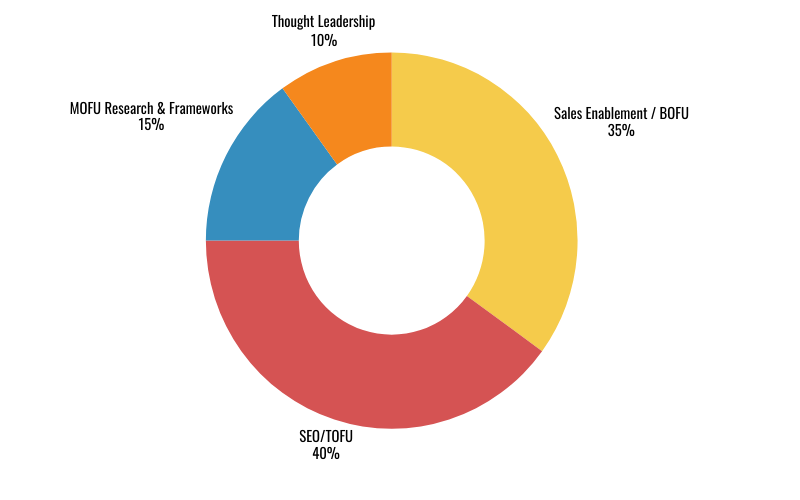
What the inbound engine was actually made of.
This is the content mix behind the inbound engine – a balance of SEO, sales enablement, and strategic deep-dives built to educate prospects, earn trust, and drive pipeline for a growing agency.
Increase in pipeline growth by Organic Search 2021-24
Pipeline generated by Organic Search 2021-25
Articles published between 2018-2024
Backlinks and citations, incl trade pubs, media pubs, & medical journals (#shrug)
Key Learnings
Building the inbound engine wasn’t just about writing strong (or stronger) content. It required architecture, quality control, and an operating mindset that could survive real constraints. These are the biggest operator insights from running a revenue-grade inbound engine as a team of one.
1. “Nice-to-have” Process Dies First. Necessity Survives.
When headcount shrinks, you find out fast what was real versus what was routine.
- Any workflow that existed for comfort – not outcomes – collapsed. Surprisingly, that included content that we’d created specifically to drive traffic to the site. Organic site traffic dipped significantly, and I had to let it happen. Talk about an ego hit – I’d spent the previous seven years of my life doing everything I could to turn a company blog into an industry trade. And had succeeded! But traffic wasn’t the goal anymore. The only metric that mattered was pipeline movement.
- The only work worth doing was the work tied to demand, clarity, and deal movement.
- The question that became non-negotiable: If I stop doing this, does revenue break?
The takeaway: Process can be helpful, but necessity is the truth. Constraint exposes the strength of any strategy.
2. Content Is Only “Marketing” Until It Leads Directly to Sales
The fastest way to sharpen an inbound engine is to build content that helps real deals move.
- I prioritized pages that appeared in the decision path for MQLs and SQLs.
- I built content around real objections heard in sales calls, not internal assumptions. And – this is important – not industry trends.
- I focused on creating assets that did two things: #1 helped prospects self-qualify, and #2 reduce friction for the Sales team by educating prospects so sales wouldn’t have to use discovery calls for influencer marketing 101
The takeaway: The highest-performing content isn’t clever. It’s useful. If sales can’t deploy it, it’s not doing its job.
3. Judgment – Not Volume – Is the Flex.
When you can’t publish at the same pace, every piece has to carry more weight.
- I tightened standards so fewer pages could do more work.
- I chose topics based on intent and revenue proximity, not editorial convenience.
- I treated publishing like a lever: fewer pulls, more impact.
The takeaway: Scale doesn’t come from output. It comes from choosing correctly.
4. “Blue Puddles” Beat Broad Competition
In a crowded market, the win isn’t always “rank for the biggest keyword.” It’s owning the gaps others ignore. This one undergirded our content strategy and enabled a 40% dip in traffic to lend itself rather nicely to an increase in the percentage of traffic we got that was actually our target customer.
- I looked for repeat questions in first-party data and sales conversations.
- I hunted for underserved angles (based on our differentiators) and unclaimed intent pockets in the market.
- I built content around those gaps – then protected them like territory. #comethru
The takeaway: You don’t have to outspend competitors. You can out-position them by owning a specific, winnable slice of intent.
5. Inbound Is Infrastructure, and Infrastructure Has Priorities
The blog wasn’t sacred. The site wasn’t sacred. What mattered was the decision path.
- Pages that didn’t support the decision journey were deprioritized.
- Maintenance work was prioritized based on impact, not completeness.
- The engine stayed stable because the essentials stayed protected: search clarity, core pages, technical health, and measurable feedback loops.
The takeaway: A revenue-grade inbound engine is a system that survives by protecting what actually keeps it running.
Check out a few more case studies
My time in marketing has been full of fun adventures. This is just one. Check out a few more.