The Minimum Viable Knowledge Graph
A Blueprint for Machine-Agnostic Visibility
Earlier in my career as a marketer, I began creating YouTube videos specifically designed to help work-from-home moms get their businesses to show up in Google search results. When the kids were at school, I made a series of videos and uploaded them to YouTube.
Imagine my dismay when none of my well-intentioned SEO videos showed up in searches about SEO. Every last one of them was shown, but only beside videos about hair.
At that time, there weren’t a lot of women talking about SEO on YouTube. And I only knew of one other Black woman who spoke about digital marketing at all. I’m a Black woman, big hair, posting a video. So, naturally, the algorithm assumed I was talking about hair.
Dude, I don’t know anything about hair. I order mine on Amazon most of the time. Or make the drive to Cherry Beauty Supply in Oak Park.
But I can’t say I was surprised – it was more a feeling of, “Hm… the algorithm has eyes, too. Noted.”
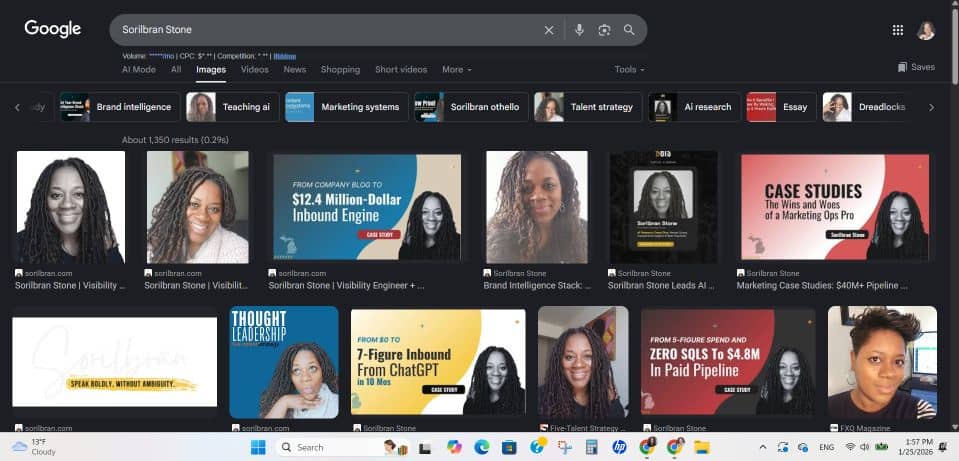
That was nine years ago. If you do a search for me in Google Images right now – in 2026 – there’s a good chance that at the top of the screen, you’ll see that Google still ties me to the category Dreadlocks, alongside topics around my area of expertise. Like it’s still not quite convinced that I’m not out here talking about hair.
Those biases are baked into the machine.
The Algorithms Aren’t Neutral
Here’s something worth mentioning: The algorithms aren’t neutral.
Not because they’re designed to be discriminatory, but because they’re trained on historical data that reflects existing patterns – patterns that include who typically gets funded, who traditionally looks like a “real business,” and whose stories get told in the media.
If you fit those patterns, the algorithms work in your favor. Traditional credibility signals – the ones machines recognize most easily – align with what you already have or can access.
If you don’t fit those patterns, you’re working against math. Not malice. Math.
The good news: Math can be accounted for.
When you understand which traditional signals you’re missing, you can build compensating signals that overcome the pattern gaps. Extra documentation. Explicit connections. Structured proof that helps machines understand your expertise even when you don’t match the default template.
Let’s talk about the signals you actually need. I think the simplest way to explain this is through an approach I call the Minimum Viable Knowledge Graph.
Quick Aside: Fifteen years on, marketing has become a behavior for me. I’m always scanning, always pattern-matching, always pushing things around in my mind and organizing them into systems. My goal here is to name and formalize a process I deploy out of habit so that you have it in your hand when you need it.
And you’re gonna need it.
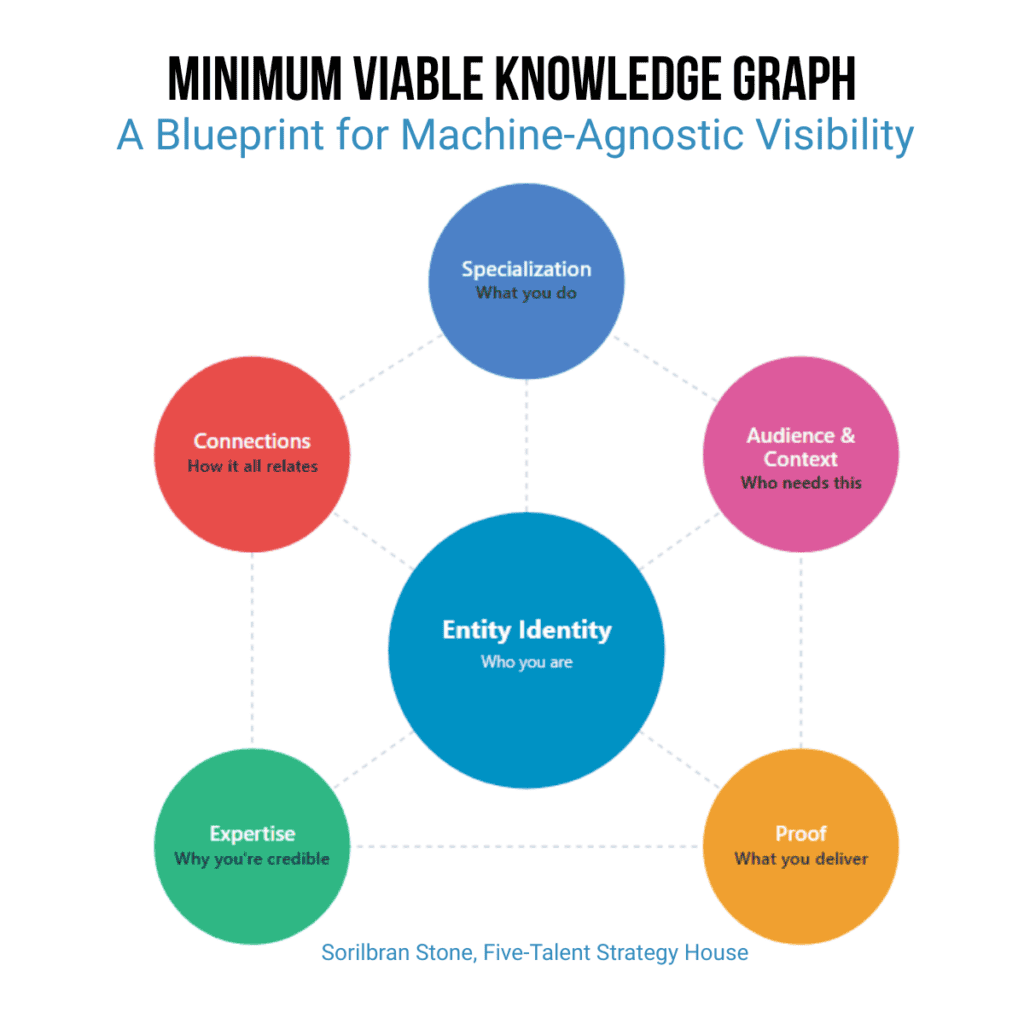
Think of MVKG as the bones of your online identity – it helps you deliberately shape yourself as an entity in machine systems. It’s not a checklist you complete once and you’re done. It’s not a guarantee that every machine will recommend you every time. It’s not even a thing people are saying out loud. But it’s an effective diagnostic process I use to help figure out where gaps are with clients – a map that allows me to be really deliberate about what data gets used to fill in those gaps.
The goal is to have a hand in authoring how machines see you – not to game the system, but to make sure the story machines tell about you actually reflects the expertise you’ve built and the value you provide.
Truth be told, I’m not sure how much longer influencing machines will be this easy. But while it is, now’s the time to seed a strong entity for your company (and the thought leaders inside your company.)
What Machines Actually Need: Semantic Structure
Most businesses already have content online. Blog posts, service pages, case studies, social media updates, testimonials. That’s enough to build a pretty strong entity. I think the problem – technical issues excepted – may lie in how machines are using the data they find about your business.
Does your website tell a cohesive story about you? Is it semantically structured in a way that keeps machines from having to intuit – because they don’t. They literally won’t. They need you to show them the explicit relationships that exist between facts that allow machines to understand not just what you say, but what you mean.
A human visitor can piece together who you are across multiple pages. Humans connect the dots naturally.
Machines don’t. They need a map. They need explicit connections. They need a knowledge graph – a structured web of facts about your business showing how everything relates.
MVKG is built on six core signal categories – or nodes – that machines prioritize when forming coherent explanations about businesses. These specific nodes are ones anyone can understand and seed to machines as content. So, no new learning – just doing the things you’ve always done in a more methodical way.
The Six Nodes: What They Are and Why They Matter
1. Identity Node – Who you are
This is your foundational signal. Your name, your role, your company, your location. Machines use this node to establish you as a distinct entity separate from others. Without clear identity signals, you become noise in a sea of similar-sounding businesses.
2. Specialization Node – What you do
This defines your core offering and methodology. Machines need explicit language about what you do, not vague descriptions. “Go-to-market strategy for B2B SaaS founders” beats “business consulting” every time. The more specific your specialization, the more confidently machines can match you to relevant queries.
3. Audience + Context Node – Who you serve and where
This tells machines who your work is for and in what contexts. Geographic signals matter (Detroit tech founders vs. Silicon Valley startups). Industry signals matter (fintech vs. healthcare). Stage signals matter (pre-seed vs. Series A). The more explicit these connections, the better machines can place you in the right conversations.
4. Proof Node – Where you’ve demonstrated results
Case studies, client testimonials, measurable outcomes, media mentions. This node answers the question: “Can they actually do what they claim?” Machines look for verifiable evidence, not just claims. Published results, named clients (when possible), and quantified outcomes strengthen this node significantly.
5. Expertise Node – How you’ve built credibility in your domain
Speaking engagements, published writing, certifications, years of experience, thought leadership. This node establishes why you’re qualified to do what you do. Machines prioritize documented expertise over self-proclaimed expertise. The more publicly verifiable your credentials, the stronger this node.
6. Connection Node – How everything fits together
This is the semantic structure that shows machines how your other five nodes relate to each other. It’s not enough to state facts – you have to explicitly connect them. How does your specialization solve your audience’s specific problems? Why does your expertise qualify you for your particular approach? How does your methodology produce the outcomes in your proof?
These connections aren’t obvious to machines. You have to draw the lines: “We specialize in move-in/move-out deep cleaning because property managers need units turnover-ready within 48 hours but don’t have in-house staff for deep sanitation. Our systematic room-by-room checklist connects to the 98% landlord satisfaction rate in our testimonials because it ensures nothing gets missed during high-pressure turnovers – preventing tenant complaints and security deposit disputes.”
If you’ve ever looked at the Related questions that follow an answer in Perplexity – these questions are a great starting point for understanding where the machine may see semantic gaps.
The point is without these explicit relationships, you have isolated facts. With them, you have a coherent story machines can traverse and explain.
Common Constraints and Compensating Signals
Constraint: New category or emerging specialization
- Compensating signals: Strengthen your Expertise Node with thought leadership content, speaking engagements, and original research. Strengthen your Connection Node by explicitly linking your new specialization to established adjacent fields and explaining why your background qualifies you for this emerging space.
Constraint: Saturated market
- Compensating signals: Strengthen your Audience + Context Node with hyper-specific targeting. Strengthen your Specialization Node with a named methodology or unique approach. Strengthen your Connection Node by explicitly stating why your methodology produces different outcomes than standard approaches.
Constraint: Non-traditional background or career path
- Compensating signals: Strengthen your Connection Node by explicitly drawing lines between your previous experience and current work – show the “because” and “therefore” relationships. Strengthen your Expertise Node by documenting your learning journey and credentialing. Strengthen your Identity Node with clear positioning statements.
Constraint: Geographic market underrepresented in your industry
- Compensating signals: Strengthen your Audience + Context Node by explicitly naming your geographic focus and the specific challenges your market faces. Strengthen your Proof Node with local case studies and testimonials. Strengthen your Connection Node by explaining why your location gives you unique insight into serving this market.
Constraint: Limited social proof or small client base
- Compensating signals: Strengthen your Expertise Node through consistent content demonstrating knowledge. Strengthen your Proof Node with detailed case studies (even from pro bono or early work). Strengthen your Connection Node by explicitly linking your methodology to the outcomes you’ve achieved, showing the mechanism of how your approach works.
The pattern: Identify which nodes are weak in your graph, then deliberately build signals in other nodes to compensate. Machines don’t need perfection across all six. They need enough clarity to form a coherent explanation of who you are and why you’re credible.
I’m not great with conclusions. So… hope this helps.