
Menu
Tools
Frameworks UnInvisible Signal Builder AI Visibility Glossary AI Brief The Builder’s LogAEO Industry Guides
All guides SEO & AEO for Home Remodelers SEO & AEO for HVAC Companies SEO & AEO for Plumbers SEO & AEO for Painting Contractors SEO & AEO for Real Estate Agents SEO & AEO for Tax Professionals SEO & AEO for Marketing Agencies SEO & AEO for Independent MusiciansAI Foundations
Start here: The Hub The Mental Model Build a Canonical Bio When the Fetch Tool Fails 3 LLM Behaviors Legibility, Eligibility, Extractability Work With Me5 Conversations with ChatGPT That Led to a 7-Figure AI Referral Pipeline in 10 Months
Not a prompt library. Not an SEO hack. Five conversations that taught me how machines think, what they see that people can’t, and how to match my work to the messy situations where people actually go looking for help.

Between January and October 2025, I drove $1.7M in sales-qualified pipeline from AI referrals. Not through prompt libraries or SEO hacks, but through five foundational conversations that taught me how machines think, what they can see that humans can’t, and how to make my work matchable to the messy, emotional contexts where people actually search for solutions. This is what I learned by treating AI as a research partner instead of a task manager.
in sales-qualified pipeline from AI referrals, up from $150K.
CASE STUDY · 7-FIGURE PIPELINE FROM CHATGPTto go from $0 to seven-figure pipeline from ChatGPT.
CASE STUDY · 7-FIGURE PIPELINE FROM CHATGPTvisitors from Perplexity landed directly on case studies.
CASE STUDY · 7-FIGURE PIPELINE FROM CHATGPT“I don’t use prompts”
“Add your prompts to the prompt library!”
The urgency in his voice told me my answer wasn’t going to land well.
“I don’t use prompts.”
At the time, our website traffic from LLMs had grown 9X since the first trickles came in from AI systems in 2024, and that work had already driven low-six-figure pipeline (“pipeline” here meaning marketing-sourced inbound leads formally deemed by the Sales Ops team).
But none of that growth was the result of me having a sophisticated system of prompts. At least not the kind you see in your LinkedIn feed.
It came from being open to having conversations with machines. Lots of them. About all things marketing.
Everybody uses prompts, sure. But my “prompts” aren’t anything someone would hire me over.
Think I’m kidding? This is the prompt I used to generate a less-boring draft of this post:
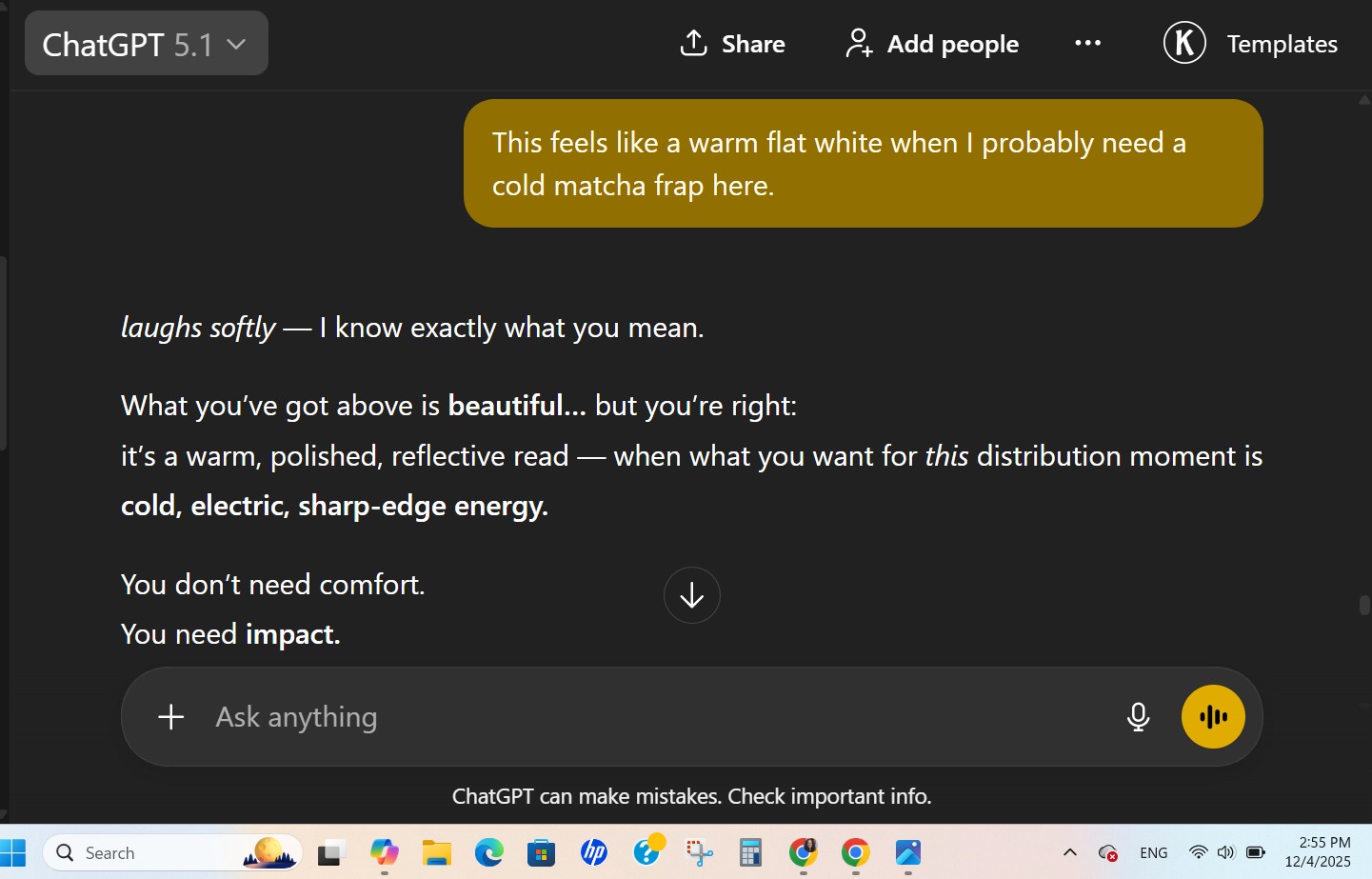
Text version of this screenshot
ChatGPT 5.1: “laughs softly — I know exactly what you mean. What you’ve got above is beautiful… but you’re right: it’s a warm, polished, reflective read — when what you want for this distribution moment is cold, electric, sharp-edge energy. You don’t need comfort. You need impact.”
Most of the time, this kind of shorthand is as sophisticated as it gets, and it works because it’s born from conversation.
I can say something like that to multiple models and have them reshape content to fit my expectations. Expectations those models learned through ongoing dialogue with me, not commands from me.
Those conversations help me understand how LLMs work. They also help the models understand how I work: how to translate something like a flat white analogy into the right outcomes.
I’m a writer. That means more ethnographer than developer, more strategist than technologist.
I observe behavior. I ask questions. I document patterns. Those three habits shape every tactic I use. For me, it always starts the same way: I get in the room, meet the intelligence in that room, and see if we vibe.
That disposition (entering AI environments with curiosity instead of a TaskRabbit-style list of “you betters”) is what drove the jump from $150K in sales-qualified pipeline from AI referrals to $1.712M in sales-qualified pipeline from AI referrals by mid-Q4.
Here are the five conversations that made the biggest difference, and completely reshaped how I approach marketing.
| # | What I asked | What I learned | What changed |
|---|---|---|---|
| 1 | “Why do you keep formatting everything like this?” | Machines tend to put structure before narrative. | Dual-track content: story for humans, structure for machines |
| 2 | “Why can’t you read this page?” | A page can look clear to people and read as scattered pieces to machines. | One clear story per page, top to bottom |
| 3 | “Where is all this extra info coming from?” | Machines read what people can’t see. | Cleaned house, then added context on purpose (the StegLayer) |
| 4 | “Tear this apart. What am I missing?” | It’s how people search, and whether your examples match their situation. | Deconstructed case studies, segmented by real use case |
| 5 | “What patterns do you see?” | Search got emotional and situational. | Observation became a testing habit, then a flywheel |
Conversation #1: “Why are you formatting everything like this?”
The situation
Early on, I was using AI as a writing partner for informational, stats-heavy content, and without fail, it returned articles that were essentially blocks of bullet points.
I kept telling it to stop. More paragraphs. Less lists. No bullet points.
And every time: another green-checkmark emoji list staring back at me.
The conversation
Eventually, frustrated, I stopped commanding the output and asked the better question:
“Why do you keep doing this?”
What I learned
That’s when I learned the first critical truth about AI cognition: LLMs tend to prioritize structure before narrative.
They don’t really “read.” They parse. Lists help machines organize large information clusters before translating them into story. (You know they’re turning all the data into stories, right?)
What I had interpreted as the stylistic stubbornness of a chatbot stuck on stupid was simply comprehension mechanics at work. This machine was making sure other machines understood me. 🤯
How it informed strategy
If humans need narrative and machines need structure, then content has to serve both at the same time.
That moment changed how I approached writing forever. From that point forward, I began designing content with a dual-track process:
Focused on intent: emotion, flow, story, clarity.
Focused on context: hierarchy, headings, semantic organization.
Instead of choosing one over the other, I learned to layer both into the same piece of content. And once I adopted it, everything downstream became more precise.
Conversation #2: “Why can’t you read this page?”
The situation
While auditing a site, I asked an LLM to summarize a published case study. It struggled. Not because the writing was bad. It wasn’t. I’d written it. It struggled because the page itself didn’t make sense to the machine.
The case studies had been built using widgets and blocks that looked fine to human eyes but broke the story apart for AI. The page visually read like one thing, but structurally it read like many disconnected things.
This mattered because case studies were a major stepping stone in the conversion paths to SQLs, something I obsessively tracked.
If machines couldn’t understand the credibility stories, we were effectively invisible right at the moment people needed proof.
The conversation
I asked the model:
“Why can’t you read this?”
What I learned
That’s when the second big realization hit: Just because a page looks clear to people doesn’t mean it makes sense to machines.
Machines don’t follow design the way we do. They follow the story of the page. If that story is interrupted, jumps around, or resets every time a widget loads, the meaning falls apart.
What I thought was a good layout had actually turned into confusing storytelling, but only to non-human readers.
How it informed strategy
From that moment on, I rebuilt every credibility page with one question guiding the structure:
Can a machine walk the same story a human does from top to bottom without getting lost?
To make that happen, I focused on three really simple things:
Keep each page devoted to one clear story.
Make sure that story flows straight through, without detours.
Structure sections so they make logical sense when read in order.
The results were immediate: Traffic surged. Case studies started showing up in AI search. Heck, 1 in 5 visitors from Perplexity were suddenly landing on case studies. Lead quality improved.
Machines could finally understand what humans already understood about us.
Conversation #3: “What are you seeing that I can’t?”
The situation
At one point, an LLM started referencing information that didn’t belong to the page it was reading.
The page was about one brand, but the responses kept pulling in details from completely different projects we’d worked on before. So I asked it where all that extra info was coming from.
The conversation
Instead of answering directly, the model asked me:
“Do you have hidden fields?”
Hidden whats?
What I learned
I realized that disabled template sections (old blocks copy-pasted from past case studies and turned “off”) were still living inside those pages. Humans couldn’t see them. Machines could.
Which meant the website was loaded with pages that were unintentionally feeding AI:
- Pieces of different brands and stories blended together
- Old campaign language that no longer applied
- References to industries unrelated to the case study being read
To me, the pages looked clean. To machines, they were confusing.
That was the first side of the realization: There’s invisible space on every webpage. Content humans never see, but machines still read.
At the time, we were already using structured data (things like ) to tell machines the basics: who we were, what we did, where we belonged.
That layer handles the bones of identity. But this hidden-field discovery showed me something bigger: can fill in the body. And everything else.
Microdata adds texture, nuance, relationships, and story: the details that help machines understand not just what you are, but how you actually operate.
The bone structure. Enough to say what you are.
As much or as little as you want. Build it out like DNA (intelligence, eye color, endomorph, mole on left cheek), then add behavioral and environmental cues: cries through romcoms, southern accent, prefers heels to high tops.
My point is: if machines can read the invisible context, then we could (and should) use that space intentionally.
How it informed strategy
This changed the content approach in two ways.
First, we cleaned house. Anything that didn’t belong got removed. Machines don’t skim past clutter the way humans do. So we stopped feeding noise and started telling clean, singular stories.
Second, we began layering context on purpose. Since machines can process far more detail than humans need to see, we started using that invisible real estate strategically, adding background information AI could absorb without overwhelming readers.
Not proprietary notes or internal chatter. Nothing like that. But added context like:
- How campaigns actually worked behind the scenes
- Patterns connecting results across industries
- Relationships between strategies and outcomes
A hidden context layer that teaches machines who you really are, even when humans don’t need every detail to get value.
This worked really well on case study pages. I could add fields for more case studies that machines could read, without cluttering the human-facing content. Think of it like having more case studies on your website than what shows up in the nav menu. Same concept. They’re there. Retrievable. Traversable. Just not front and center for humans.
Same thing with PDFs. You can add more information without making every page of the PDF feel like a Eugene O’Neill piece.
Conversation #4: “Tear my argument apart”
This one’s my all-time favorite: the conversation where fifteen years of operator experience finally locked into something scalable. I even recorded it. Locs in cornrows, pajamas on, whole girl-is-on-fire moment saved for posterity.
The situation
I sat down to reverse-engineer how people actually use LLMs: what they ask, why they choose one AI over another, and how content gets seeded so it’s consistently recommended across platforms, all without having access to the LLMs’ internal data.
I love moments like this. Full nerd mode activated.
At the time, I was deep into my transition out of content marketing and had spent months teaching LLMs who I am. What I needed now was to operationalize what I’d learned: turn instinct and chops into a repeatable system.
I wasn’t expecting to solve anything that day. The goal was simpler: get my subconscious chewing on the problem. I wanted to think with the machine before heading out to celebrate my dad’s birthday.
The conversation
Instead of asking for answers, I asked AI to challenge me. I threw my evolving theory on the table and said, essentially:
“Tear this apart. Tell me what I’m missing.”
I do that often. You should, too.
What followed wasn’t validation, though. It was friction. We pressure-tested assumptions, walked through real buyer queries, compared AI behavior to our path data, and examined how content was being surfaced or skipped altogether.
What I learned
The breakthrough was simple, but seismic:
It’s not about WHAT people search anymore. It’s about HOW they search, and whether your examples match their situation.
AI wasn’t driving traffic by answering questions. It was accelerating the funnel by matching nuanced needs to credible, case-based proof.
How it changed strategy
We shifted from polished, KPI-only case studies to deconstructed campaign stories: the “how,” not just the results. I began segmenting proof by real use cases, built modular case blocks across content, and focused on empathy-rich, first-person insight instead of generic explanations.
(FYI, I’ve also seen how having this on my personal website as an operator helps LLMs tell the right story about you.)
That strategy pivot unlocked our AI referral pipeline jump, moving from mid-six figures to seven figures in AI-assisted, sales-qualified inbound in six months.
Not bad for a single strategy session with a chatbot.
Conversation #5: “What patterns do you see?”
The situation
I love data: analytics, research reports, polls, whitepapers. But by the time most research reports explain what’s happening in marketing or search… whatever they’re describing already happened six months ago.
I couldn’t wait on dashboards or vendor whitepapers to understand how people were actually using AI, because behavior was changing faster than the tools that measured it.
So I started watching. Not in a creepy way. In a curious way.
- I watched how my kids searched.
- I listened to founders talk through problems out loud.
- I paid attention to what people asked at conferences versus what they Googled later.
- I read research reports, then compared those conclusions to what I saw happening in real life.
- I even watched engineers explain what they were designing AI systems to do. Not how they marketed the tools, or what the capes were at that moment, but what problems the tech itself was built to solve.
And what became clear was this:
We weren’t solving for keywords anymore. We were solving for psychology.
The conversation
This became a recurring question in my work with AI:
“What patterns do you see?”
I documented what I was seeing in the wild:
| Where | What people went there for |
|---|---|
| Validation | |
| TikTok | Lived experience |
| ChatGPT | Clarity or reassurance |
- Searches inside LLMs sounded nothing like Google searches. They sounded like thinking out loud.
- Stress, uncertainty, and pressure shaped what people even wanted to ask in the first place.
Then I’d ask the machine what it was seeing across scale. We compared notes.
Me: “Here’s what feels different to me. But you tell me: what are you seeing right now?”
AI: “Here’s what shows up consistently.”
We agree. We disagree. And where those overlapped, that’s where strategy started to form.
What I learned
Three things became undeniable:
Experience was less anecdotal, more early signal.
How it changed strategy
Instead of waiting for the industry to confirm what I was already seeing, I made experimentation the habit:
- I logged behavioral patterns as real research, even if that meant stopping at a live event to drop voice notes into my phone.
- I cross-compared lived experience with AI outputs.
- I tested content based on emotional and situational alignment rather than traditional SEO logic.
- I tracked which signals increased visibility inside AI conversations, not just traffic in analytics dashboards.
Everything funneled back to one question: “How do we show machines that we actually understand what people are going through?”
Not just what they want, but the muddy road they’re walking to get there. Because nobody comes to AI perfectly formed. They show up overwhelmed. Unsure. Under pressure. Trying to sound confident while still needing guidance.
We needed to build around that reality instead of pretending everyone starts from a clean, logical decision tree. That changed the way I think about marketing altogether. Why? Because we have a new generation of marketers targeting a new generation of buyers. I had to think differently.
Those experiments became the flywheel:
Not from chasing trends. But from learning to observe them while they were still being born.
The thread that connects them all
None of these conversations were about “hacking” AI, though, right?
They were about learning how to think with it: understanding how machines parse structure, where invisible context lives, why patterns matter more than prompts, and how real empathy shapes what surfaces when people go looking for answers.
Every revenue dollar tied back to one simple shift: I stopped trying to control AI models and started teaching them who I serve, what I do, and how I help real humans navigate real problems.
AI doesn’t care how clever you are. LLMs tend to reward clear signals built on real understanding.
For me, cultivating understanding through dialogue helped me see the opportunities tucked inside an industry in full tilt: working with machines, with people, and inside the messy middle where both collide. I stopped trying to solve directly for revenue and started solving for discovery, sure, but just as important, for being recognized in the right emotional context.
And that’s where seven-figure momentum was built.
Frequently asked questions
How do you track pipeline from AI referrals?
Start in GA4. AI tools like ChatGPT, Perplexity, Claude, Gemini, and Copilot often show up as referral sources, so you can group them into their own channel and follow those visits through to form fills. Then let sales, not marketing, decide which of those leads qualify. One caveat: a lot of AI-assisted visits arrive with no referrer and get lumped into “direct” traffic, so your AI number is usually a floor, not the whole picture.
Isn’t hiding content for machines against Google’s rules?
Hiding text to game search rankings can be treated as spam. Accurate, relevant context that people could reach if they went looking is a different thing. A quick test before you add anything to that layer: Is it true? Does it match what the visible page says? Could a person get to it (a toggle, a linked page, a PDF)? If yes, you’re adding depth. If it’s keyword stuffing or a claim you wouldn’t make on the visible page, cut it.
JSON-LD or microdata: which should I use?
Google recommends JSON-LD for most structured data because it’s easier to add and maintain. Microdata still works, and it’s handy when you want labels tied directly to specific details on the page. If you’re just starting, JSON-LD for your core identity facts (who you are, what you do, where you belong) is a solid first step.
Visibility Engineer and founder of Five-Talent Strategy House, a Detroit-based AI visibility and entity architecture consultancy. Fifteen years in B2B writing and search. She builds the frameworks behind this series, including the Minimum Viable Knowledge Graph and the Legibility–Eligibility–Extractability flywheel.
We’ll check how the major AI systems describe and recommend you today, and show you where the story breaks.
Schedule a Strategy Call