Menu
Tools
Frameworks UnInvisible Signal Builder AI Visibility Glossary AI Brief The Builder’s LogAEO Industry Guides
All guides SEO & AEO for Home Remodelers SEO & AEO for HVAC Companies SEO & AEO for Plumbers SEO & AEO for Painting Contractors SEO & AEO for Real Estate Agents SEO & AEO for Tax Professionals SEO & AEO for Marketing Agencies SEO & AEO for Independent MusiciansAI Foundations
Start here: The Hub The Mental Model Build a Canonical Bio When the Fetch Tool Fails 3 LLM Behaviors Legibility, Eligibility, Extractability The Minimum Viable Knowledge Graph Work With MeBuild a Canonical Bio That Teaches AI Systems Who You Are
Your bio is the first brick in your online identity, and it can have an outsized effect on how you show up in AI systems. Here’s how to build the one version of you that everything else points back to.
AI systems don’t keep a file on you. They assemble you in real time from everything they can find, then look for agreement. When your bios disagree, they hedge, or they pick an older version of you.
The fix is one deliberate, current bio on your own website that everything else echoes. Five questions, two to four paragraphs, updated before anything else when your work changes.
Most professionals have a bio somewhere.
You may have two on LinkedIn, one long and one short. There’s probably an About page on your website. Or at least a paragraph that was supposed to become one. Maybe a speaker profile from something you submitted two years ago. A podcast guest intro you emailed a host at 11pm. A directory listing from a professional association you joined and forgot about.
None of them is wrong, exactly. But chances are good that none of them fully agree with each other, either. That used to be okay. In fact, years ago, I encouraged folks to keep multiple bios: different versions of your heroic story, told specifically for the intended audience.
But now…
Multiple versions of you scattered around the web? That’s a structural problem. And you may not even realize you have it until you search for yourself (or worse, someone else searches for you) and find something unexpected looking back.
This piece is about fixing that. Specifically, it’s about building a single source of truth in the form of a canonical bio: one authoritative, deliberate, current statement of who you are, living on a page you own, that everything else in your online presence points back to and agrees with.
Identity infrastructure. It’s the first brick in how people and machines come to understand who you are.
How machines find, evaluate, and choose who to recommend, one layer at a time. Read the mental model →
Why This Matters More Now Than It Used To
The way people find and vet professionals has changed.
Search engines have always pulled from multiple sources to build a picture of who you are. But AI-powered discovery systems like ChatGPT, Perplexity, Gemini, and Copilot have raised the stakes on consistency.
AI doesn’t know you. When someone asks an AI assistant about you, or searches for someone who does what you do, the system isn’t pulling from a single file it keeps on you. It’s assembling you in real time from whatever signals it can find: your website, your LinkedIn, your mentions in articles, your author profiles, your directory listings, your old bios that never got updated.
Then it looks for agreement.
Same name, same role, same focus, same story. The system builds that picture with confidence. It can describe you clearly. It can recommend you.
The system hedges. It qualifies. It says things like “details about her exact current roles and achievements can vary by context and source.” That’s not a neutral outcome. That’s the machine telling anyone who asks: I’m not sure who this person is right now.
And here’s the hiccup: you probably won’t know when this is happening. You don’t get a notification that an AI described you wrong. You’re just out here, not showing up when you should be.
A canonical bio, consistently signaled, is how you become the author of the loudest and clearest signal in that process. It gives machines and people something authoritative to find.
What Canonical Actually Means
is a term borrowed from web development. Back in my SEO days, canonical was law. When multiple URLs contain the same or similar content, developers designate one as the canonical source: the original, the authoritative version, the one that counts. That became really important once the industry started syndicating and repurposing content.
A canonical bio is one authoritative, current statement of who you are, published on a page you own, that every other bio and profile online agrees with in substance.
A canonical bio is the master record. The one you wrote deliberately, that reflects who you are right now, that lives somewhere permanent. Everything else (the LinkedIn summary, the speaker intro, the social profiles, the podcast guest bios) should pull from it, echo it, agree with it.
Not word for word, necessarily. But in substance: the same name, the same core description of what you do, the same framing of who you serve, the same story.
How does that look IRL? Here’s an example. In a few places online, it says I’m an award-winning writer. My canonical bio names the actual award (the Agnes Bruenton Award) and the piece of work that won (Cookie).
When your presence agrees with itself across platforms, that consistency is a signal in its own right.
It says: this person has a clear, stable identity. Here is the source.
Why It Has to Live on Your Website
You might be thinking: my LinkedIn is more visible than my website. More people see it. Why not make that the canonical source?
Because LinkedIn is rented space.
Every social platform, every third-party profile, every directory listing lives on infrastructure someone else owns and controls. Algorithms change. Platforms get acquired. Features disappear. Terms of service get updated. What happens if LinkedIn gets enough pushback from users about AI scraping that it blocks search engines and AI systems from reading the platform, and you’ve made it your single source of truth? Frustration, that’s what. And probably an inconveniently timed rebuild.
Your website is the only real estate you actually own. It’s the only place where you’re permanently the authority, where nothing you say can be overridden by a platform decision you didn’t make.
When you establish your canonical bio on your own domain and signal it consistently across your ecosystem, you’re telling every search engine and AI system: this is the source. Start here. When in doubt, defer to this.
That matters when platforms change. It matters when a listing gets scraped wrong. It matters when an old piece of content resurfaces and conflicts with who you are now. Your website is the anchor. Everything else is a spoke pointing back to it.
What a Canonical Bio Contains
Keep it straightforward. You’re answering five questions.
- 01Who are you?
Your name, your professional identity, and any relevant context about where you operate or what you’ve built.
- 02What do you do?
Not a job title. A clear description of the work. What does it actually look like when someone works with you or learns from you?
- 03Who do you do it for?
Be specific. “Businesses” is not an answer. “Founder-led companies trying to figure out why their marketing stopped working” is an answer.
- 04What do they get from knowing you?
What changes for someone after they’ve worked with you, read your work, or followed your thinking? This is your value, plainly stated.
- 05Where do they go next?
A clear path forward. What’s the most useful next step for someone who wants to know more, hire you, or follow your work?
Write it the way you’d introduce yourself to someone worth impressing at dinner. Not keyword-stuffed. Not title-stacked. Plain language a non-specialist can read and understand immediately, because AI systems, like humans, favor clarity over jargon.
Length doesn’t need to be precious. Two to four paragraphs is plenty. Long enough to be complete, short enough to actually get read.
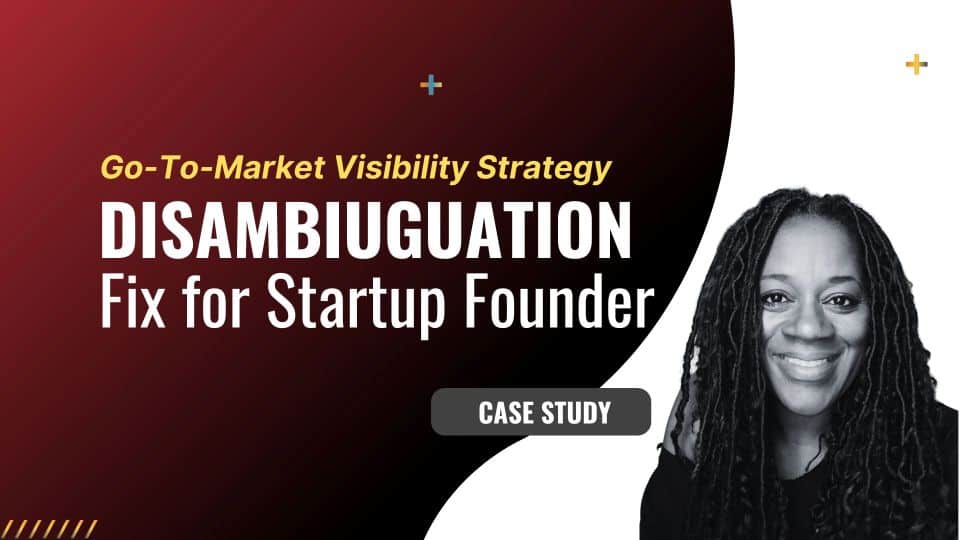
A startup founder was building a real estate marketplace for Guyana, with traction, ambition, and a name shared by several other people. AI systems were routing to the wrong person. Eight days after the intervention, a five-LLM audit showed what changed, and what the machines revealed about how they decide who exists.
- Domain purchased and all platforms updated within 48 hours.
- 2 of 5 AI systems at high-confidence resolution by day 8.
- Perplexity surfaced the entity fingerprint cluster unprompted.
- ChatGPT cited legal privacy frameworks, and explained exactly which signals were missing.
The Consistency Layer: Making It Work Across Platforms
Writing the bio is step one. Deploying it is step two. This is where you want to be deliberate so you don’t leave value on the table.
Once you have your canonical bio, go through every platform where you have a meaningful presence and make sure the substance agrees.
| Where | What to align |
|---|---|
| The most important external platform to align. Your headline, About section, and featured content should reflect the same core identity. They don’t have to be identical (LinkedIn has its own native voice), but they should tell the same story. | |
| Email signature, speaker profiles, guest bios | Pull directly from your canonical bio. When a podcast host asks for a bio, send yours. Not a custom version that introduces new language the machines have never seen. |
| Social profiles | At minimum, a consistent name and a link back to your website. The link matters. It tells systems this profile and this website are the same entity. |
| Directory listings and author profiles | Often overlooked and frequently outdated. Go find yours. Update them. Anywhere your name appears professionally is a data point in how machines understand you, and outdated data points create friction. |
The goal isn’t identical copy everywhere. It’s agreement in substance. Same name. Same core description. Same story. One master record that everything else reflects.
A Note on Keeping It Current
Your canonical bio isn’t a set-it-and-forget-it asset. It should evolve as your work evolves.
You don’t need to update it constantly. That creates its own kind of noise. But when something meaningfully changes (your focus shifts, you launch something significant, your audience changes, you move), update the canonical bio first, then let the other platforms follow.
Think of it as updating the master file before you update the copies.
Here’s why it matters: AI systems don’t have a fixed memory of you. They assemble you from current signals on a rolling basis, and how long that “roll” is depends on the platform. I call Perplexity the “fastest learner” because it pulls in real time and relies heavily on what it retrieves, not just what it was trained on. If your canonical bio still describes who you were two years ago, that’s what they’re working with. Keeping it current keeps the record accurate.
Tracking Professional Evolution
When things happened matters as much as what happened. If your goal is to become recommendable in AI systems, keep in mind that machines don’t just want to know who you are. They want to understand the shape of your professional story: how you got here, what changed, why.
If your canonical bio says you’re an AI visibility engineer, but your old author bio is still floating around saying you write productivity books, the system has to reconcile those two things. Are they two different people? Did you pivot? When?
Without a clear timeline, the machine fills in the blanks. And it might fill them in wrong.
This is where the temporal layer comes in. Your canonical bio should make clear: here’s who I am now. Your LinkedIn, your website, your media kit, and your speaker profiles should all reflect that same current version of you.
Your professional history should be traceable, not erased.
If you wrote books five years ago, that’s real. It happened. But it should be placed in your timeline, in sequence, so the machine understands it as part of your journey, not your current identity. (Here’s what that looks like on my About page.)
A Quick Story to Drive This Thing Home
At the beginning of February, I unpublished some old books I’d written. Not a big deal, right? They were from an earlier chapter: productivity guides, women’s empowerment content, work-at-home mom advice. Good work, but not where I am now. I pulled them off my Amazon shelf to update them, refresh them, and get them right before re-releasing.
What I didn’t know was that Amazon was an in my knowledge graph.
When I removed those books, I didn’t just clean up my shelf. I yanked a structural pillar out from under how AI systems understood who I was. And the systems did exactly what systems do when a signal goes dark: they went looking for a replacement.
They found one. Barnes & Noble. Everand. Old listings. Old descriptions. Old me.
-
I unpublish the old books on Amazon.
An authority node goes dark. Nothing looks different from the outside.
-
Perplexity hedges.
I’ve worked in this space long enough to know that when I change something, I check how it changed my story in the machines. So I searched “Who is Sorilbran Stone?” and got this back:
“Because there isn’t a single canonical bio widely recognized across all sources, details about her exact current roles and achievements can vary by context and source.”
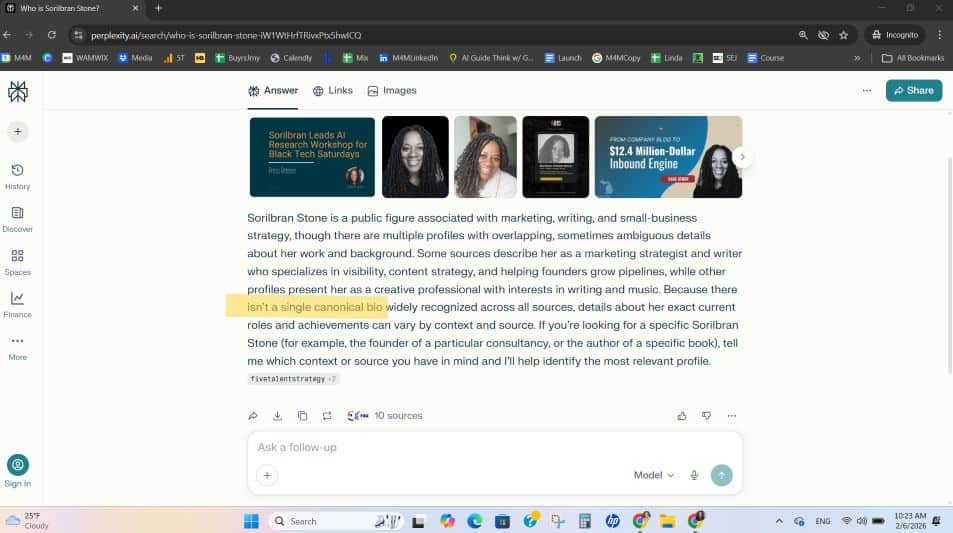
The machine telling me, in plain language: I can’t find agreement. I don’t know who you are. -
Perplexity stops hedging and decides.
It decided I was someone I used to be. Productivity books. Small-business guidance for women. Atlanta-based author. All accurate, for 2016. Not for now.
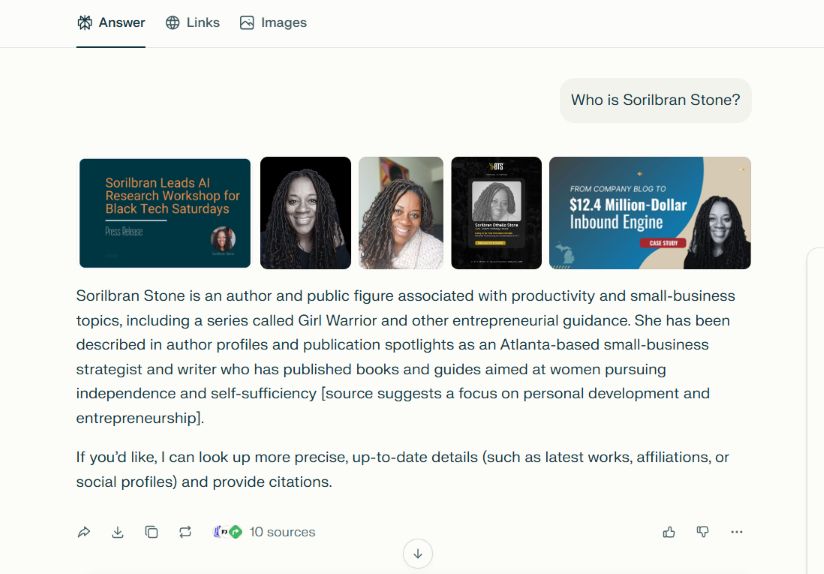
Mid-regression: without those decade-old Amazon nodes, the machine is more confident in the older version of me while it reweights my identity. -
The canonical bio goes live, and the machine settles.
Thirteen days from the first hedge to a stable answer.
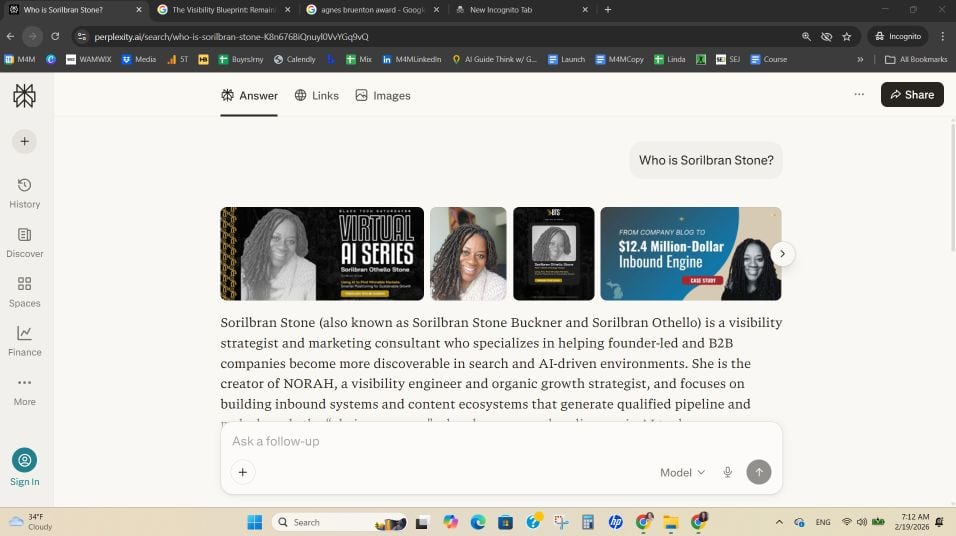
Me and the machine making peace, after I filled in the gaps with a canonical bio.
Ten years of professional evolution, gone for a stretch. Not because I did something wrong. Because I removed a source, and the AI filled the vacuum with whatever it could find.
Identity regression is when AI systems fall back to an older version of you after a key source about you disappears or your current signals conflict.
And… it happens.
You better believe I got right on that canonical bio (you can see mine here). It’s not that I didn’t have a bio on my site. I did. But I didn’t have one that accounted for the stories I’d been telling about myself in different places at different times. Or the story Amazon had been telling about me, a story that mattered more to the machine’s understanding of who I am than I realized.
Without a canonical bio tying everything together, the machine reprioritized the signals that made up my identity and reassembled me over a few days into a completely different story. Wild, right? And fascinating. I’m truly fascinated by its outsized response to that one Amazon node disappearing.
A truly canonical bio would have stabilized my identity, at least in how the machines saw me and weighted everything.
I’m okay with this version of me being picked up by other AI systems. But if you’re in a competitive market and you and the machines spend two weeks figuring out who you are, that’s a heck of a lot of opportunity on the line.
How to Know It’s Working
Search for yourself. Not just on Google. On ChatGPT, on Perplexity, on whatever AI tools your clients or peers are likely to use.
Who is [your name]?Who does [what you do] in [your location or industry]?
Does what comes back reflect your current work? Does the story hold together? Or are you getting a version of yourself that’s hedged, outdated, or just slightly off?
If what you find doesn’t match what you’d want people to find, the canonical bio is where you start. Fix the source. Let the signal propagate. Then check again.
Start Here
You don’t need a complete website overhaul. You don’t need a rebrand. You don’t need to become an SEO specialist or hire one.
You need one page, on your website, with one deliberate, current, accurate statement of who you are: written plainly, linked to consistently, updated when your work evolves.
Then you need everything else to agree with it. That’s the first brick. Everything else in how machines and people understand you builds on top of it.
If you don’t lay it deliberately, something else becomes the foundation by default. And you probably won’t know which version of you is holding up the wall.
Frequently asked questions
Should my canonical bio be written in first person or third person?
Third person usually travels better. It’s the version other people can paste as-is (podcast hosts, event pages, directories), so the same wording shows up everywhere and the agreement is easy for machines to spot. You can still keep a first-person version on your About page, as long as the facts match.
Should I delete old profiles and bios that don’t match anymore?
Usually not. Update the ones you control so they agree with your canonical bio. For the ones you can’t change, give them context instead of trying to erase them: name that earlier chapter on your own site, with dates. Deleting a source the machines relied on is exactly how my identity regression started.
Do I need schema markup on my canonical bio page?
You don’t need it for the bio to work, but it helps. Person schema on that page, with sameAs links to your LinkedIn and other official profiles, states in machine-readable form that those profiles are you. It’s a small add that removes guesswork, especially if you share a name with someone else.
What if I share a name with other people?
Then consistency matters even more, and you’ll want extra signals that tie the right accounts together: the same profile photo, the same headline wording, links between every profile and your site, and a distinct detail (your city, your company, your niche) repeated everywhere. The startup founder case study walks through a real fix.
Visibility Engineer and founder of Five-Talent Strategy House, a Detroit-based AI visibility and entity architecture consultancy. Sixteen years in B2B writing and search. She builds the frameworks behind this series, including the Minimum Viable Knowledge Graph and the LEE Model.
We’ll check how AI systems describe you right now, find where your signals disagree, and show you what to fix first.
Schedule a Strategy Call