Menu
Case Studies
All case studies Fixing a Founder’s Disambiguation The One-Person Inbound Engine Fixing Google Ads 7-Figure Pipeline from ChatGPT Blog to $12.4M Inbound EngineTools
All toolsFree tools
Canonical Bio BuilderPaid tools
Signal BuilderReference materials
AI Visibility Glossary UnInvisible AI BriefModels / Frameworks
The Framework Library The Builder’s LogAEO Industry Guides
All guides SEO & AEO for Home Remodelers SEO & AEO for HVAC Companies SEO & AEO for Plumbers SEO & AEO for Painting Contractors SEO & AEO for Real Estate Agents SEO & AEO for Tax Professionals SEO & AEO for Marketing Agencies SEO & AEO for Independent MusiciansAEO Basics
Start here: The Hub The Mental Model Build a Canonical Bio When the Fetch Tool Fails 3 LLM Behaviors Legibility, Eligibility, Extractability The Minimum Viable Knowledge Graph Work With MeWhat Your Sales Calls Know That Your Ads Don’t
How 24 sales calls, a gutted team, and 42 dead ads turned into the framework I still use to find winnable markets.
A Blue Puddle is a small, specific, winnable pool of market demand hiding inside real buyer language — often in sales calls, customer conversations, AI prompts, or support tickets — before the broader market has organized around it.
In January 2025, I was taking a powder (old-timey term for taking a break) for my annual bout with COVID when I got a call from the new head of growth at the marketing agency where I was working: “You need to fire your team by Wednesday.” It was Friday.
Writers, social media manager, my right hand, video creators… That week sucked. So, let’s skip ahead.
By February, the head of growth was gone, too. Suddenly, I was the only strategist and the only one on hand to deploy. And I had a serious problem — the velocity at which leads were coming into the pipeline was slowing drastically, and I’d just lost my team.
This was pre-Cowork and before Computer was running AI audits. The chatbot-only days of AI. And it happened a few months after the brand ecosystems revelation I talked about in part one of the Blue Puddles origin story.
The ads stopped working. Not completely. But dramatically enough for both Sales and the leadership team to be alarmed. Once ChatGPT taught me Google Ads and I learned how to read the data behind the “clicks are up” reports the ad agency had been sending, I could tell that something was really wrong.
The same ads that had driven $5M in qualified pipeline the year before, converting at 38%, were sending the same amount of traffic to landing pages that weren’t converting anymore. Something had changed. We were losing big deals from Fortune 100 brands. Our team of seasoned, proven sales professionals could no longer close them in calls. So, if it wasn’t the sales team, and the messaging was the same, the thing that changed had to be the conversation — what prospects were asking for in calls.
Mining first-party data
So, I spent days mining first-party data — analyzing sales calls. 15 brands, 24 calls, comparing conversations in the current quarter to conversations in the previous two quarters. Working with my AI assistant, Maverick, to save the day. Or at least save my job.
sales calls analyzed
brands across industries
quarters of conversations compared
“What patterns are you seeing, Maverick?”
“I’m gonna drop the text from their original form-fill that talks about their goals. Is our team addressing their goals in sales calls?”
“They seem hesitant to spend, right? Is that what you’re seeing? What patterns are you picking up in their language?”
I was right — the conversations had changed. Brands were asking for different outcomes than they had in the previous two quarters — across companies, across industries. Brands were still reaching out, but now they wanted test campaigns where they had been putting down six- and seven-figure spend before. They wanted performance metrics where they’d wanted awareness before. They wanted us to own more of the purchase path, whereas before top-funnel was enough. And there was an urgency now that the AI flagged in the calls that told me they were up against pressure.
These weren’t companies who were still trying to figure out influencer spend. They understood the tactic; some understood the strategies. But their definition of success had changed. All of the companies — whether they were big companies that owned a portfolio of brands that lined the shelves of American homes, or smaller brands that wanted to run cool campaigns. Suddenly, awareness wasn’t enough, and a six-figure minimum spend was too much.
“Give me a list of their asks, Maverick — what they’re actually saying they want when they get on these calls. Pull exact language.”
Maverick did so.
“Now uncover their actual pain points — the problems they’re trying to solve — and tell me about intent — their actual goals.”
I saw the gap. Maverick did, too.
There was a gap between what prospects said, wanted, and needed, and what we were actually selling them in calls. And in our ads.
More, the same callers who would have been lighthearted and more generous with flexibility a year before were now signaling urgency and uncertainty in calls. Pressure from higher-ups.
Pipeline recovery, step one: kill 42 of 44 ads
First things first — I killed 42 out of 44 ads. Most of them had stopped performing anyway and were just eating up budget. None of them seemed to reflect any real strategy. We were bidding on keywords that our organic work would have covered. We were also bidding on similar keyword groups across ads, meaning if we had Venn-diagrammed them, there’d be so much overlap that the whole thing would just look like one bumpy, weirdly colored circle.
None of the ads optimized for specific pain points. None of the ads segmented traffic based on campaign goals or even industry.
Creative for B2B campaigns went to the same landing page as ads for UGC campaigns. All of the language was general:
- #1 Agency
- Top Agency
- The Best Influencers
So, I thought, “What if we just doubled down on ads that addressed the specific needs of our ICP — not the general market? Not the stuff we ‘should’ be running ads for — just stuff we’re hearing in sales calls?”
No differentiating ourselves from competitors. No positioning ourselves as the best of anything. Just parroting what the sales team had heard in calls.
I told Maverick to rebuild our ad stack, using their exact language in the landing pages, and putting their specific pain point in the ad copy.
That’s what we did.
What happens in ChatGPT shows up in your transcripts
I knew from watching how people were using ChatGPT that people dumped their worries into the machine and let it sense-make. I mean… regular people don’t prompt AIs the way marketers who’re using team accounts with vibe-killing token ceilings prompt AI systems. They prompt like stressed buyers trying to explain what they need by contextualizing their frustrations.
I also knew people didn’t fully trust the machines yet. And based on what I gleaned from watching seven seasons of The Mentalist, if their worries go unresolved, they’ll talk about them again — almost verbatim — in sales calls. You know, to test the machine. To test the vendor. To see if a human can make sense of the thing the machine helped them name.
What happened in ChatGPT didn’t just stay in ChatGPT. It also showed up in our transcripts.
Which meant… first-party data would be our engine for getting leads from AI systems.
Finding the gap competitors missed
So, I asked Maverick to lift out a handful of themes from the 24 calls that we needed to address on the site in order to show up in AI systems. I pulled copy from the home pages of our competitors and dropped them into Maverick’s capable digital hands.
“Find the gap. Stuff that’s showing up in our sales calls that our competitors haven’t doubled down on.”
And Maverick did: performance-driven influencer, AI-enabled tech, creative + strategy. I updated the home page, refined services pages, rebuilt our case studies pages (a few dozen of them), and added entire hubs to the nav menu to signal importance. And ALL of it was based on what was happening in the sales calls.
I realized that those sales conversations were the key to actual differentiation with machines. Not value prop stuff that your PR agency will handle. But differences between a brand and its competitors that actually manifested in a way machines could parse, trust, corroborate, and extract right from the website.
In a crowded market, all the big ideas — the common ideas — have become red oceans. We didn’t need one or two big Blue Oceans. We needed a half-dozen tiny bodies of water where actual market demand was evident, even if it was just in language we repeatedly heard in sales calls.
Because that is where the signal usually is.
Where demand actually lives
This didn’t start with sales calls. It started at the movies.
Back in 2024, before I had a name for any of this, I wrote about how fandom extends the life of cinematic storytelling. Thanos. The Moana 2 dance challenge. Red One. The studios weren’t the ones carrying those stories across TikTok and YouTube. The fans were. In their own words, on their own feeds, on their own timing.
Part 1 was the business side of that same idea: Amazon treating Red One as a door into an ecosystem instead of a ticket sale. And this part is the same truth showing up in a pipeline. The buyers had already said what they wanted. Out loud. On recorded calls. We just weren’t listening in their language.
Three different rooms. Same lesson:
Demand lives in the market’s language. Not the brand’s.
Now, I’m not saying your value prop doesn’t matter. It does. It’s the language that separates you from your competitors. But it shows up late in the buying process. Demand shows up way earlier.
Think about how your feed works. Say I’ve been talking (on my phone, or near my phone) about a trip to South America. It’s just a consideration. I know some people down there. I’m thinking about it. Then the algorithms start showing me South America: travel YouTubers, safest-places lists, where the deals are. That’s interest. But once I start clicking, the feed usually changes. It stops showing me inspiration and starts testing where I am. Am I ready for hotel deals? Flights? New luggage? The algorithm changes what it shows me based on where it thinks I am in the process.
Your content has to do the same thing. Different language for different points in the decision.
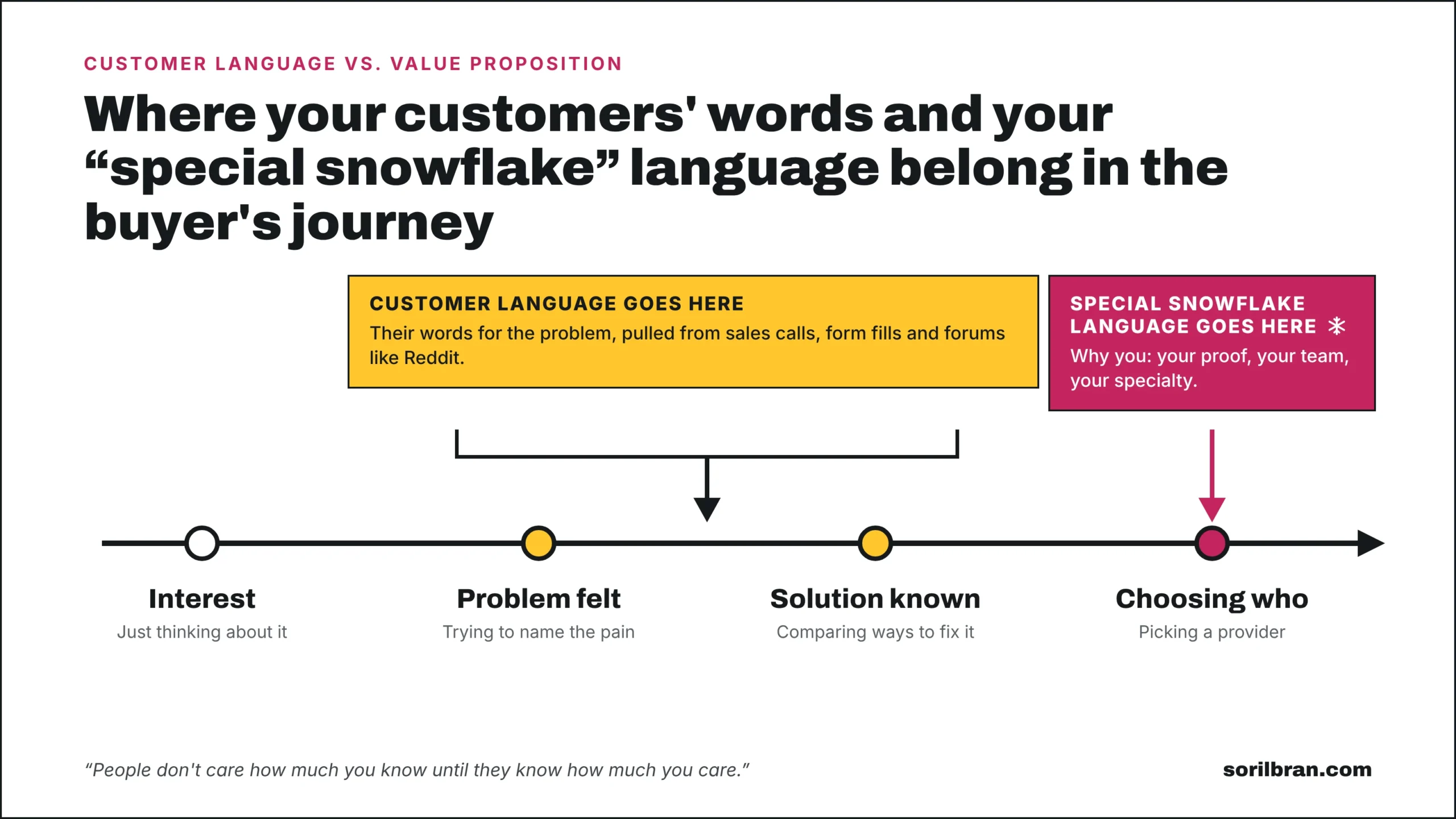
Customer language (the language of demand) lives early: lower top of the funnel into the upper middle, where buyers have felt the pain and are trying to name it. Keyword Planner, Google Trends, AEO tools and AI category answers are useful here, but they tell you what’s on buyers’ minds. They don’t tell you the words. The words come from your first-party data (sales calls, form fills, support tickets) and, if you don’t have enough of that yet, from places like Reddit and other forums where buyers describe their problems in their own language. That little sliver of real language? That’s where your copy lives.
Special snowflake language (your value prop) goes way down. After they’ve seen you answer their question. After they’ve looked at a couple of other places, skimmed the zero-click results and watched a bunch of YouTube videos. Now they’re deciding who to do business with. That’s when “do business with me because…” earns its spot: this is our team, this is what we specialize in, this is why we’re uniquely equipped for your specific problem.
My former pastor used to say, “People don’t care how much you know until they know how much you care.” Until is the operative word. Customer language is the caring part: proof that you heard the problem the way they said it. Special snowflake language is the knowing part. It only lands after the caring has.
Read this image as text
The buyer’s journey has four stages: Interest (just thinking about it), Problem felt (trying to name the pain), Solution known (comparing ways to fix it) and Choosing who (picking a provider).
Customer language belongs in the middle two stages, Problem felt and Solution known. It’s the buyer’s own words for the problem, pulled from sales calls, form fills and forums like Reddit.
Special snowflake language (your value proposition) belongs in the last stage, Choosing who. It’s why you: your proof, your team and your specialty.
That’s why “#1 Agency” died. It was special snowflake language sitting at the top of the funnel, announcing itself to people who hadn’t asked anything yet. And that’s why “performance-driven influencer” worked. It was customer language: the buyers’ own words for what they wanted, at the point they were trying to name it. Competitors were still talking about awareness. And the receipts (years of campaign data) did the special snowflake work further down, on the case studies.
Same thing at the movies. The dance challenge didn’t invent the urge to dance and post. That was already happening on TikTok. The movie gave fans a version worth copying.
So a Blue Puddle isn’t just a pocket of demand. It’s a pocket of demand nobody has answered in the buyer’s language yet.
What the performance hub looked like
So, what did that look like? Well, let’s use performance-driven influencer as an example.
Read the hub as text
I built a performance marketing page and inserted it as a drop-down in the nav menu. The performance marketing page served as parent to two related pages: one on allowlisting and another on the performance optimization engine. The allowlisting page itself covered our process and POV on allowlisting. It included an internal link to a blog post on allowlisting strategy with campaign examples. The optimization page explained how our proprietary tech optimized continually and why that mattered for performance campaigns.
But that wasn’t all that was in the Performance drop-down menu. I also included a page dedicated to case studies that had driven clicks and sales. Old and new. And finally, all four of those pages had CTA buttons that went to a form-fill page, riddled with performance-focused proof stats and a few more performance case studies.
I also built a narrative for machines to grab onto because we had receipts to back it up: performance-driven influencer wasn’t new and trendy for us — we were always about that life. I updated older case studies for machine readability, and began recycling stats from years-old campaigns because even though the agency had been prioritizing awareness wins for those older campaigns, a significant percentage of them had resulted in clicks and sales.
So, I spotlighted them, making the campaign dates and KPIs appear in close proximity to establish a track record. Not new content — the case studies already existed. Just reorganizing how things showed up together and creating modular HTML blocks that allowed me to pull stats from any case study and lift out specific angles from campaigns we’d already run.
Worked a treat.
What the machines sent back
AI-sourced traffic began landing directly on the performance hub. Not the homepage. Not some vague blog post. The hub.
I’d used the case studies to create a set of doors for all sorts of nuanced asks: brands looking for clicks-focused fashion campaigns, home goods campaigns that needed to influence revenue, food campaigns where the CMO wanted sales. And that’s exactly who started ending up in calls.
Not only that, but the LLMs started identifying the agency as a performance-driven influencer agency.
That mattered. Because when AI environments started sending people directly to those pages, it confirmed something I had suspected. Those buyer conversations were not just sales insights.
- They were search signals.
- They were AI visibility signals.
- They were doorways.
Then the patterns got more interesting. The increase in traffic from AI environments allowed me to get better at reading how and when people were using different AI systems.
GA4’s Path Exploration revealed that Perplexity traffic behaved differently from ChatGPT traffic.
A meaningful share of Perplexity visits went directly to case studies, which told me those were likely lower-funnel conversations. People were not just asking broad educational questions there like they were in Claude. They were looking for proof. They were comparing. They were trying to decide who could actually do the work.
That is when the idea started to sharpen. Understanding ICP asks could help do more than get brands more traffic from AI systems. Sales conversations could also help startups enter the right market.
From a pipeline problem to a framework
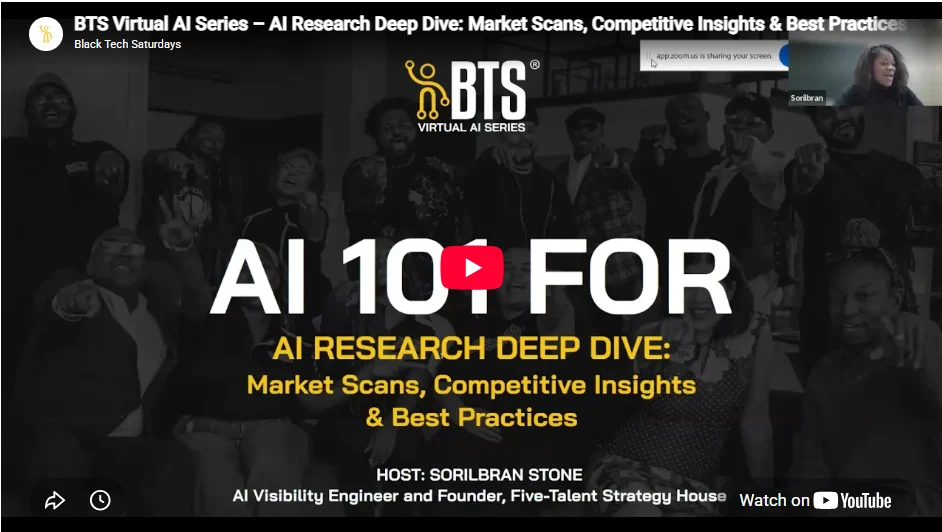
By fall, I’d gotten pretty good at this game. I transitioned out of my role at the influencer agency, and began sharing insights with the wider Detroit startup community. I was asked to teach a workshop as part of the Black Tech Saturdays ecosystem on using AI for research. I built the presentation for bootstrapped founders who had more ideas than time.
 BTS Virtual AI Series · AI Research Deep DiveWatch on YouTube ↗
I taught people that there are little pools of intent hiding inside the sales conversations, and if they can have enough of those sales conversations, they would be able to find the exact market to compete in — one with unmet demand that would position them for massive success as a startup or micro business.
And that’s how Blue Puddles became an actual framework.
And eventually, it became the logic behind NORAH, the GTM intelligence platform I started sketching after this.
NORAH was based on the same premise: if you can mine sales calls, form fills, customer conversations, competitor positioning, and market language, you can find the pockets of demand other companies are missing.
Not the giant obvious market. The winnable market. The Blue Puddle.
The place where buyers are already asking for something, but the category has not made it easy to find, compare, or choose yet.
I didn’t set out to name a framework. I was trying to survive a pipeline problem.
But somewhere inside those 24 sales calls, I found the thing I’d been looking for: not a blue ocean, not even a blue lake. A small, winnable body of demand. A Blue Puddle.
And uh… that’s how the sausage got made.
The receipts
Fixing Google Ads: From Zero SQLs to a Clean, Intent-Driven Pipeline
How I turned a five-figure Google Ads program with zero SQLs into a clean, intent-aligned acquisition engine that generated $4.8M in pipeline.
- +260% generic CTR after moving to intent clusters
- 650% conversion rate lift after rebuilding landing page alignment
- 35% lower CPL without increasing spend
- Recovered and quarantined all corrupted Q3 data from a bot attack
From $0 to 7-Figure Pipeline from ChatGPT in 10 Months
How I rebuilt a high-growth agency’s web ecosystem so ChatGPT, Perplexity, and other LLMs could understand who they are, what they do, and when to recommend them.
- 497% year-over-year growth in LLM-driven traffic
- $1.7M in pipeline directly attributed to AI-driven discovery
- ChatGPT became the second-highest converting lead channel at ~27%
Frequently asked questions
Can I find Blue Puddles without recorded sales calls?
Yes. Recordings make it easier, but any place buyers describe their problem in their own words works: the goals field on your contact form, call notes your sales team already writes, support tickets, proposal requests, emails, and chat logs. Pull the exact phrases, not summaries, and look for the same ask showing up across different buyers.
When three or four unrelated buyers describe the same need in similar words, and competitors aren’t addressing it on their sites, you’re probably looking at a Blue Puddle.
Visibility Engineer and founder of Five-Talent Strategy House, a Detroit-based AI visibility and entity architecture consultancy. Sixteen years in B2B writing and search. Origin Stories are where her frameworks come from: the real situations, usually messy, where a repeatable pattern first showed up.
On a strategy call, we’ll look at your sales conversations and find the Blue Puddles hiding in them.
Schedule a Strategy Call