
AEO Is Exposing Cross-Functional Growth Problems for Lean Teams
For years, it made sense to treat visibility as a ranking problem. A page ranked, got clicked, and sent traffic. But large language models don’t work like a simple list of blue links generated from a 7-word query. Large language models assemble answers in real time from a mix of training data, retrieval systems, corroboration, and confidence signals. And typically they’re operating on context gleaned from something significantly more detailed than a 7-word query.
That changes the practical question from “Can we rank?” to “Can a machine understand what we are, decide we’re safe to use, and pull something useful from our body of work without it being distorted?”
AEO is exposing a cross-functional growth problem.
Machines read your entire stack as one trust environment — not separate SEO, RevOps, product, and CX projects.
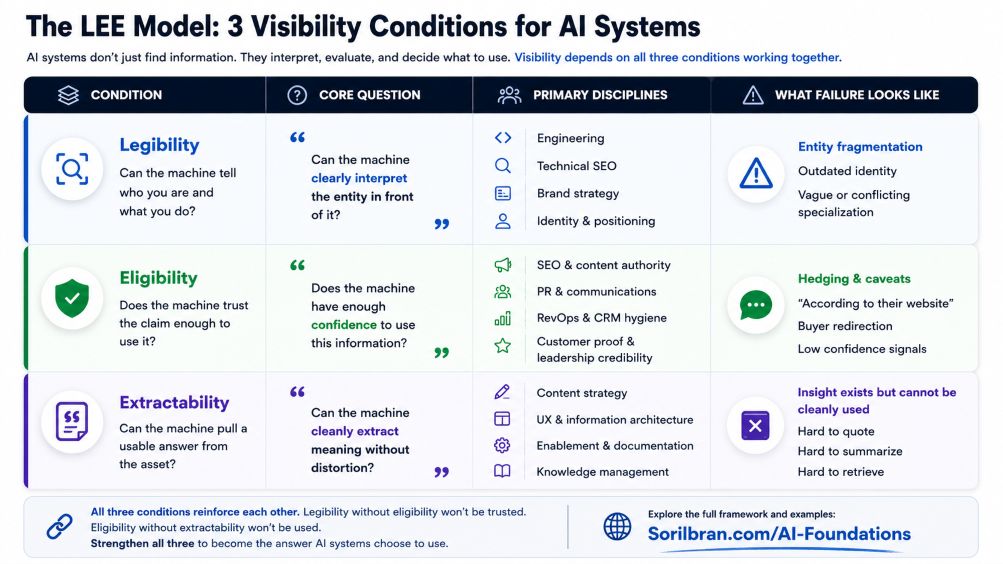
The LEE Model describes three visibility conditions: Legibility, Eligibility, and Extractability.
For lean teams, visibility now depends on aligning entity clarity, proof, and content structure together — not just publishing more content.
How AI is rewiring the relationships between teams
Historically, it was possible to treat marketing, product, engineering, sales, and RevOps as mostly separate tracks.
- Product shipped features
- Marketing translated them into campaigns and content
- Sales told their own version in decks and demos
- RevOps stitched the numbers and data together after the fact
- Engineering sat underneath it all, keeping the site and tools alive
As long as Google was the main discovery surface, that separation was painful but survivable. You could win a whole lot of visibility in the SERPS with a sharp content strategy, a decent site, and a few strong backlinks.
But AI has added a new element to traditional search that’s worth incorporating into your growth strategy. Currently, about 19% of US adults say they use an AI tool every day, which feels modest – feels like AI is still emerging and earning its keep. Now, when we direct our attention to search, adoption shifts. 37% of US consumers start their searches with AI instead of Google, according to Eight Oh Two’s 2026 Search and AI Behavior Study. But even with Google searches, 87% of us read the AI-generated summaries.
When a model assembles an answer about your category, it pulls from product docs, landing pages, help articles, case studies, PR, reviews, user forums, LinkedIn profiles, and whatever else it can find that looks stable and trustworthy. It doesn’t stop to ask which department produced which asset. It just sees one entity and one stack of signals and uses those signals to answer queries.
That changes the relationships:
Product ↔ Marketing
Product language is no longer internal. Feature names, release notes, and docs become entity signals. If marketing and product describe the same thing differently, machines get conflicting stories about what you actually do. Coordinated naming, definitions, and “what this is” copy are now visibility work, not just brand work.
Marketing ↔ Engineering
Dev decisions – URL patterns, schema, sitemaps, how you structure docs – shape machine legibility. Marketing decisions – which stories to tell, how specific to be, how you structure proof – shape eligibility and extractability. You do not get stable AI visibility without both in the room.
Marketing ↔ RevOps / Sales
If eligibility is about trust, then the CRM and sales notes are where the real proof lives. When RevOps treats data quality as “just ops,” and marketing treats case studies as “just content,” you end up with a wedge between the story machines can see publicly and the story your closed‑won data is telling privately. Best case scenario, AI sends you referrals, but they will be from those most likely to click, not those most likely to buy. Worst case – AI will resolve that wedge in favor of whoever looks more stable from the outside – usually an incumbent.
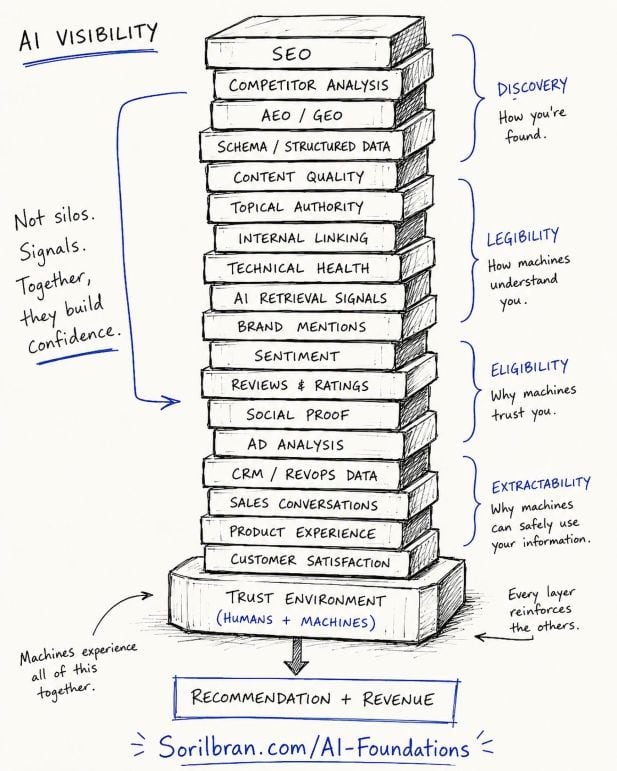
Now, this is a model for thinking about how things fit together, and I’m sharing this with the keen understanding that 92% of business leaders at companies that have some form of data governance in place recognize their team members lack the data fluency to properly analyze data. And for small orgs, the data analyst is likely someone already in your organization who has a free Friday night that they’re using to drop screenshots into Claude with the query: “What am I looking at here?” So, I recognize that in practical terms, this may seem a bit tone deaf.
BUT the point I’m driving home is that AI visibility – whether it shows up as recall, retrieval, or inference – is a cross‑functional growth opportunity (not problem) that happens to show up first as weird search behavior. Meaning, even before you get someone in to handle the marketing activities, the effectiveness of your marketing will depend on your diligence with product, engineering, positioning, data collection, and sales today.
Lean teams get hit hardest, but enjoy the most upside when they get it right
Lean teams struggle with the shift in search and retrieval for a number of reasons. It’s not unusual for the members of a small team to perform multiple roles under a single title. The founder who built the product also spun up the website. A technical co‑founder hacked the platform together with Claude, but nobody is thinking about markup, internal linking, or crawl paths. A CMO doubles as the head of sales. Someone is posting on social, someone is writing the occasional blog, and no one owns how all of it reads as one system to machines.
In that environment – super lean, founder-led firms – the default growth motion is almost always relationships supplemented by ads. Pipeline comes from events, referrals, DMs, and outbound. Every opportunity is directly tied to effort the founder or a small team puts in. And without an engine under the surface turning search and retrieval into a second channel, there’s always more outbound to do. Remember the movie Fifty First Dates? It’s that.
When AI starts mediating discovery, lean teams get hit hardest because all of the manual work they put in has no structural counterpart in the places AI actually looks. The identity is fragmented, but the cost of that fragmentation is invisible until the founder notices that inbound never really materializes.
That is also where the upside lives. Because the stack is small, a few good decisions move the needle quickly. When a lean team aligns product language, sharpens entity clarity, surfaces proof in source‑ready ways, and makes content structurally easy to extract, they are giving themselves a way for one day of founder effort to be reused by many systems, instead of re‑spent in every single conversation.
The LEE Model: Solving a cross‑functional problem
The LEE Model (Legibility, Eligibility, and Extractability) is a way of understanding the visibility conditions organizations can create in AI-mediated environments.
Legibility is whether systems can clearly tell who you are and what you do. Eligibility is whether they feel confident enough to use or recommend you. Extractability is whether they can safely pull usable meaning from your work.
Together, they create an interdependent set of conditions that make an organization easier for AI systems to understand, retrieve from, and recommend in context.
Think about a B2B software company publishing a case study about pipeline growth. The dev team affects whether the site exposes clean structure, valid schema, and stable pages. Marketing affects whether the company is clearly positioned and corroborated. RevOps affects whether the claim is actually connected to trustworthy source data inside the CRM. Content affects whether the result is packaged in a way a machine can safely extract.
If any one of those layers breaks, visibility is compromised. Here’s what that looks like practically: the brand may be known but not trusted, trusted but hard to parse, or structurally sound but impossible to recommend because the proof is thin.
In LEE terms, lean teams get outsized results when they become radically legible, reliably eligible, and unusually easy to extract from. Because once that trust environment is in place, every human‑powered motion they already know how to run suddenly becomes easier for AI systems to see, understand, and recommend.
What AEO is ultimately exposing is not just a visibility problem, but an organizational coherence problem.
Generative systems don’t see companies the way org charts do. Most companies barely experience their day-to-day based on what’s in the org chart.
AI systems don’t separate product from marketing, marketing from sales, sales from RevOps, or customer experience from reputation. They assemble all of it together while trying to answer: “Can I confidently understand and recommend this entity?”
Large language models are generative, probabilistic systems where entity coherence makes the difference between being seen, cited, surfaced, or skipped altogether.
The more fragmented the signals:
- the more ambiguity increases
- the more confidence drops
- and the more likely the machine is to default toward your competitors, safer interpretations, or generalized answers.
Which means…
the companies that win in AI-mediated environments may not be the ones producing the most content. They may just be the ones whose identity, proof, language, systems, and customer reality reinforce one another clearly enough for both humans and machines to trust them.