
Menu
Tools
Frameworks UnInvisible Signal Builder AI Visibility Glossary AI Brief The Builder’s LogAEO Industry Guides
All guides SEO & AEO for Home Remodelers SEO & AEO for HVAC Companies SEO & AEO for Plumbers SEO & AEO for Painting Contractors SEO & AEO for Real Estate Agents SEO & AEO for Tax Professionals SEO & AEO for Marketing Agencies SEO & AEO for Independent MusiciansAI Foundations
Start here: The Hub The Mental Model Build a Canonical Bio When the Fetch Tool Fails 3 LLM Behaviors Legibility, Eligibility, Extractability Work With MeFox Buying Roku Is About More Than Streaming
Fox’s $22 billion deal for Roku would put a news company in charge of the recommendation engine that shapes what millions of households discover on TV.
A media company at the center of a news empire that shapes narratives across the US, the UK, and Australia wants to buy a . One that would let it shape what Roku users see in their feeds, observe their viewing habits, and gather behavioral intelligence on a platform that reaches more than half of US broadband households. Flip the alert status to orange, please.
For all the chatter about Fox News being the place where conservatives can feel at home, Fox has never been morally conservative. But it has become exceptionally good at finding and leveraging attention, across age groups.
Who Fox is as a player in media
The first place I went when I really began thinking through the implications of the deal was Google, to get an idea of who and what Fox actually is today. When I think of Fox, I think of TV in the early 1990s. I think of Nat Geo and 21st Century Fox. But is that even who Fox is today?
The answer’s no. Disney bought 21st Century Fox, Nat Geo included, in 2019. What’s left, Fox Corporation, is a leaner company built around news, sports, and live TV.
Fox is a news organization
Today, Fox is first and foremost a news organization. And it sits inside a larger Murdoch-controlled media family with deep roots in Westernized markets: Fox Corporation runs Fox News and the Fox broadcast network in the US, while its sister company, News Corp, owns newspapers and news brands in the US, the UK, and Australia. Across those regions, the family has doubled down on owning the flow of information, particularly TV news and newspapers. Not haphazardly. Intentionally.
We’re talking about fast-moving, high-impact stories that can be brought directly to a target audience and delivered in a way that bakes in urgency, leads with the stakes (whether real or imagined), and gets an immediate response.
Fox Sports: high emotion, high conversion
And then there’s Fox Sports. Sports are the only remaining frontier where people will make an appointment with themselves to watch an event live. I wouldn’t call myself a sports fan, but part of me LIVES for UFC fight nights. Weigh-in, pre-show, the whole nine. I’m not unusual there. The Comcast Advertising report open in the last tab on my screen says 84% of sports viewers watch the Big Four (MLB, NFL, NBA, NHL), and 90% watch sports outside the Big Four.
Nothing wrong there. But live sports is another category where things happen in real time, the urgency and emotion are baked in, the stakes are front and center, and the response is immediate.
That shows up in the ads, too. Live sports are becoming a blue ocean for advertisers because the audience isn’t just watching. They’re emotionally activated, watching in real time, and often on a second screen while the event is happening.
of CTV viewers say they pay attention to ads during live sports, and 74% want more relevant messaging.
THE TRADE DESKof live sports viewers multitask during events, and 71% prefer ads that include live scores and updates.
LG AD SOLUTIONS · FEB 2025That matters because sports ads aren’t seen as interruptions. In the right context, they become part of the live-event experience. The psychology here is pretty straightforward: emotion helps encode memory. When people are already in a heightened state (waiting for the next play, reacting to a momentum shift, texting friends, checking stats, watching betting lines), the ad environment becomes more valuable. Hello, $8 million Super Bowl spots.
So sports don’t just give Fox live attention. They give Fox a real-time lab for understanding which messages, brands, products, identities, and calls to action move people while they’re already activated.
How that eventually affects the price of ads, I guess we’ll find out. Won’t we?
Fox already owns Tubi
In 2020, Fox acquired Tubi, one of the largest free, ad-supported streaming services around. By Tubi’s own numbers, it has a catalog of more than 300,000 titles (including about 400 Tubi originals) and roughly 100 million monthly active users, most of them millennials and Gen Z from multicultural backgrounds. About 6 in 10 don’t subscribe to traditional cable TV, the audience skews slightly male (59% vs. 40% female), and 95% of viewing time goes to on-demand content. Tubi users streamed more than 10 billion hours in 2024. (Tubi)
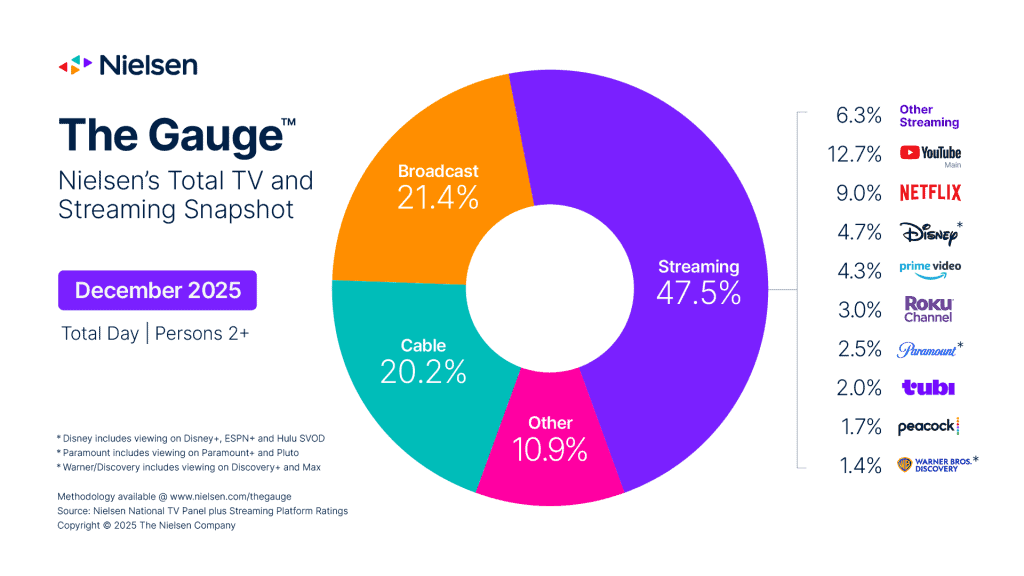
Right now, streaming accounts for 47.5% of all TV viewing in the US (Nielsen). Tubi gets about 2% of total TV viewing. Adding Roku would push Fox to roughly 5%.
But what happens when Fox takes ownership of the streaming ecosystem?
Well, you’d still be able to check out all your favorite streaming services. Fox isn’t going to hide the apps and make them undiscoverable on Roku. That’d turn people off and make them abandon Roku.
But owning the ecosystem isn’t my main thing.
The problem with a news organization owning Roku’s intelligence engine
Roku isn’t just a streaming platform where you can watch movies for free. A Roku TV runs on an operating system undergirded by a recommendation engine that learns from its users.
That means a news organization that paid $787.5 million in 2023 to settle Dominion Voting Systems’ defamation suit over its 2020 election coverage would essentially own the of more than 100 million streaming households: Roku’s user base.
That’s on top of the intel from Tubi’s roughly 100 million users it already owns.
And yeah, there’s overlap between the Tubi audience and the Roku audience. But by Roku’s own count, it’s the #1 TV streaming platform in the US and reaches more than half of US broadband households, while the Tubi app can be downloaded onto any smart TV.
So we’re looking at the company behind the most-watched cable news network in the US, a hands-down favorite of Americans over 50 (47% of adults 65 and older and 45% of those ages 50 to 64 say they regularly get news from Fox News)…
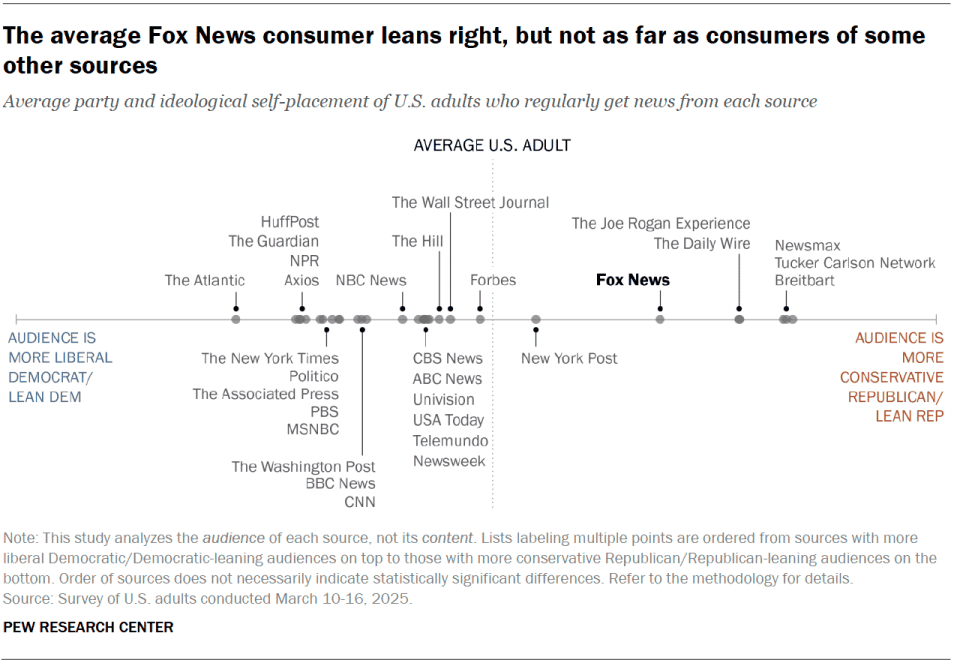
…acquiring a recommendation engine that would let it watch the behaviors of a younger cohort (what they watch, which platforms they visit, how long they stay, what they search) and then tailor content to those behaviors.
Okay. The data part of the evening is over.
Fox is a content company buying the front door to discovery
I’m curious about the endgame of a media company that has basically earned its living by controlling the news (broadcast news and newspapers) and then building a large catalog of entertainment IP.
Why would that company now double down on a discovery engine that essentially controls the flow of entertainment?
To be clear, this isn’t about not wanting to be influenced by conservative or right-leaning news. Right-leaning, left-leaning: I’m not watching Fox News, and I’m not watching NBC News. Present me with the facts. I’ll make my own decision.
AND…
While people are out here saying Fox News is so conservative, I don’t want to gloss over the fact that Fox is also the network that gave us Peter Griffin’s sodomy song, introduced us to Herbert the Pervert, let Bart Simpson raise hell for nearly 40 years, and fundamentally reshaped the narrative and archetype of the American family.
So…
It brings me back to my original thought, which is: I don’t like this.
From a discovery perspective, having a content company control the gate (the doors through which content gets discovered) feels significant.
If you’re feeding older Americans a narrative in the form of “news” while shaping what younger people see on the most popular free streaming platforms, that’s the kind of influence that could architect new culture from scratch.
I wouldn’t be surprised if the next investment leans toward a social media platform.
It all feels very free market, but not necessarily productive or protective for the American people, or for the future of American culture, psychology, and well-being.
Where the deal stands
Fox announced the $22 billion deal on June 15, 2026 and expects it to close in the first half of 2027, pending shareholder and regulatory approval. In September 2026, the US Justice Department issued a “second request”, which means a deeper antitrust review before the deal can go through.
So, that’s where I am with Fox’s plan to buy Roku right now.
It feels precarious. It’s weird to me that the government would even consider allowing such a thing. There’s nothing intrinsically wrong with the business move. But there’s everything wrong with one media family being able to so completely control the flow of information across three continents. Everything.
Platforms decide what gets seen. We help you build visibility that doesn’t depend on any one gatekeeper.
Schedule a Strategy Call