
Menu
Case Studies
All case studies Fixing a Founder’s Disambiguation The One-Person Inbound Engine Fixing Google Ads 7-Figure Pipeline from ChatGPT Blog to $12.4M Inbound EngineTools
All toolsFree tools
Canonical Bio BuilderPaid tools
Signal BuilderReference materials
AI Visibility Glossary UnInvisible AI BriefModels / Frameworks
The Framework Library The Builder’s LogAEO Industry Guides
All guides SEO & AEO for Home Remodelers SEO & AEO for HVAC Companies SEO & AEO for Plumbers SEO & AEO for Painting Contractors SEO & AEO for Real Estate Agents SEO & AEO for Tax Professionals SEO & AEO for Marketing Agencies SEO & AEO for Independent MusiciansAEO Basics
Start here: The Hub The Mental Model Build a Canonical Bio When the Fetch Tool Fails 3 LLM Behaviors Legibility, Eligibility, Extractability The Minimum Viable Knowledge Graph Work With MeBlue Puddles, Pt. 1: What a $250M Box Office “Flop” Taught Me About Brand Ecosystems
How getting outvoted by my kids accidentally built a framework.

This part: the idea of a brand ecosystem. Next: rebuilding a pipeline with first-party data. Read Part 2 →
- Red One “flopped” at the box office and Amazon shrugged, because the theatrical run was there to pay for the marketing.
- The real value lives downstream: subscribers, rewatches, merch, sequels. The movie is just the format the IP took.
- Every brand needs to think like a studio now. Each piece of content is a door, and each door brings in a different kind of person.
Outvoted by My Kids
My kids wanted to see The Wild Robot.
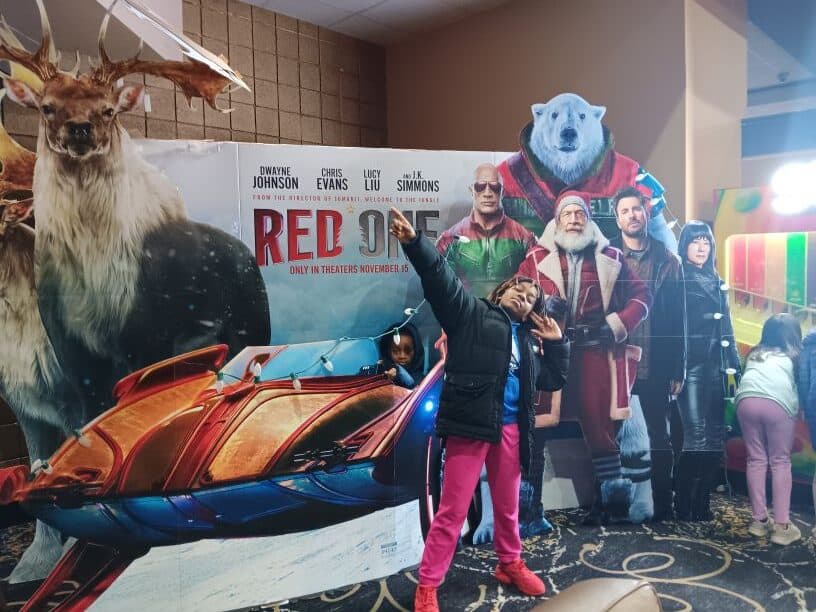
I wanted to see Red One. Lucy Liu. Chris Evans. Dwayne Johnson. Jacked Santa. I thought this was an obvious call.
Plus, my kids attended the ballet school a block over from where Red One was filmed (the toy car scene). My daughter told me about the day one of the girls came in and said, “The Rock and Chris Evans are filming a movie down the street!” Teens and tweens dropping their refinement long enough to run out the door of the ballet school in black leotards and pink tights.
Despite all of that, we ended up seeing The Wild Robot. And it turned out to be a solid choice.
Monday morning, I did what I always do: I went looking for info on the movie I was still planning to see. Depending on how well it did at the box office, I’d decide whether I was seeing it in theaters or at home on the sofa.
$32M Recouped. $218M to Go.
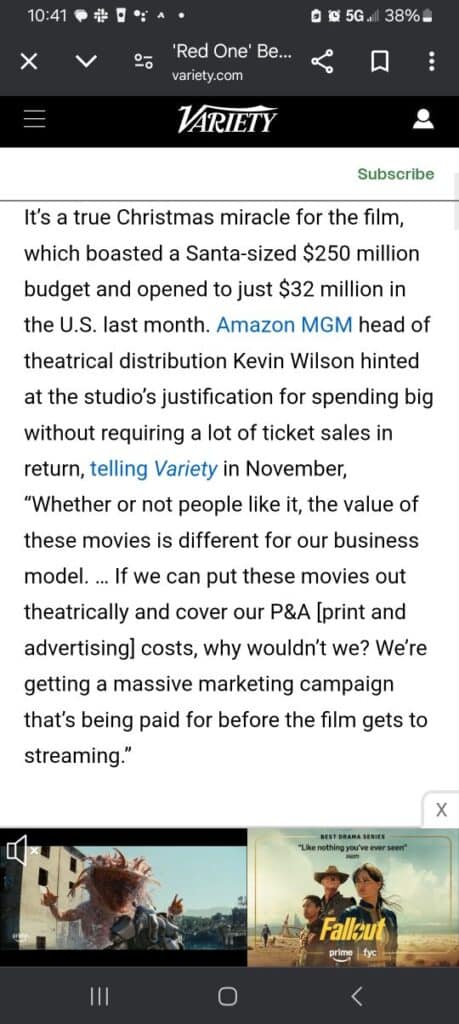
The headlines said Red One bombed. On the heels of billion-dollar Marvel runs, this movie took in $32 million on opening weekend, for a movie that cost a reported $250 million to make. That sounds like a flop.
The gap the headlines called a flop
$250M − $32MAnd then I found one quote. One of the higher-ups at Amazon MGM said they didn’t yet know whether the movie was a success.
Since when are box office numbers not the success metric for a movie?
Read this image as text
In coverage of the opening weekend, Kevin Wilson, Amazon MGM’s head of theatrical distribution, explained that films like Red One are valued differently under Amazon’s business model. If a theatrical release covers the print and advertising costs, the studio gets a large marketing campaign paid for before the film reaches Prime Video. (Variety, November 2024)
I asked ChatGPT: How is this not a flop? Give me the math.
It didn’t give me math. It gave me something better. It broke down how Amazon MGM actually thinks about IP. Not as films. As assets.
| The headline lens | The ecosystem lens | |
|---|---|---|
| The movie is | A product | A door into the platform |
| Success means | Ticket sales | Subscribers, rewatches, merch, sequels |
| The theatrical run pays for | The movie | The marketing |
| The timeline | Opening weekend | Every holiday season, for years |
Merchandising. Red One action figures showing up on Amazon in the weeks before Christmas, because we’d watch it every year now, the way families watch Elf and Home Alone and Krampus.
Syndication rights. Licensing the movie out to other networks and platforms.
Sequels and spinoffs. A potential TV show. A sequel. More doors from the same IP.
Subscriber acquisition. Every family that loaded it up on Prime Video on Christmas Eve is now a subscriber who stays for The Terminal List and everything else Amazon owns.
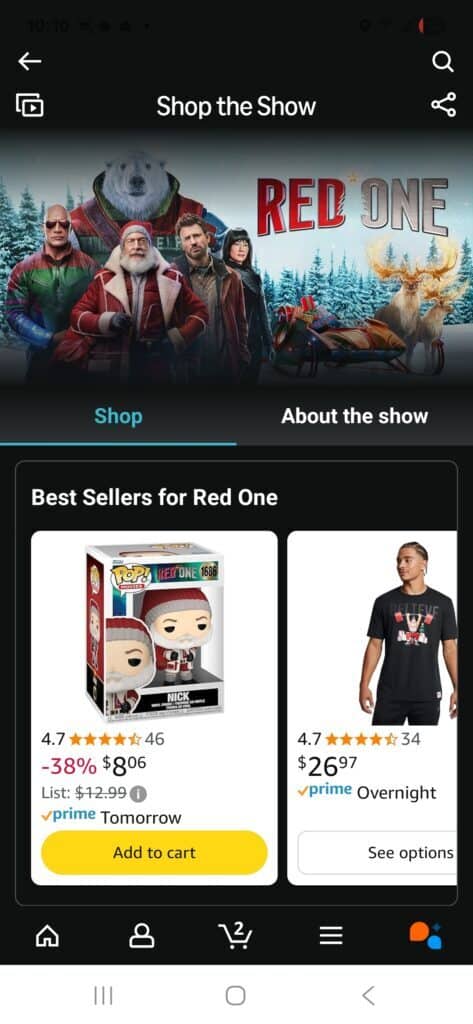
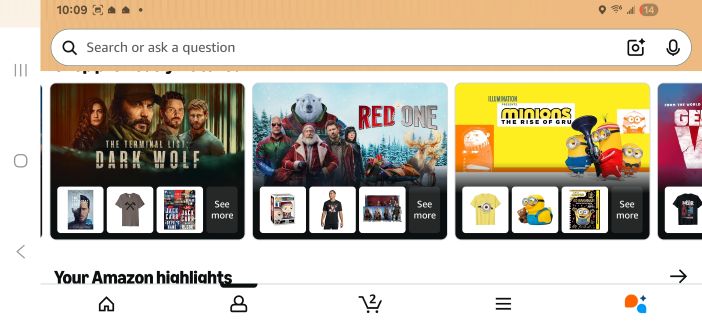
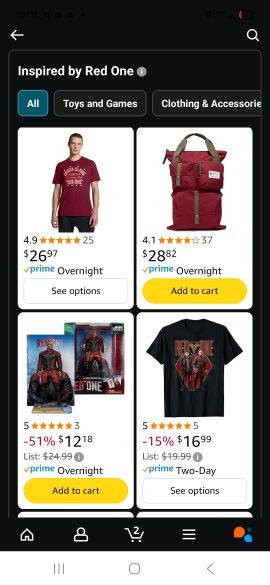
Turns out, the theatrical run was just to cover the marketing budget. The real money (the money that compounds for decades if they bet on the right IP) lives downstream. In every new subscriber, every rewatch, every related purchase attributed to Red One.
The goal of the movie is to get people into Amazon’s ecosystem so they can discover five other things they love on the same platform.
The Rabbit Hole Is the Business Model
Most of us have had that experience: finding one thing you like that sends you into a bunch of related things.
I like Chris Pratt movies. He’s always giving girl dad energy. Perfect brown noise before bed. My favorite? The Magnificent Seven, though I’ve watched The Tomorrow War a zillion times. But his involvement with The Terminal List compelled me to read the book (which I loved). Then I watched the series on Amazon (which I loved way less). But I “second-chanced” the franchise when the prequel, The Terminal List: Dark Wolf, came out, and I’ve since watched it dozens of times.
- DOORChris Pratt movies
- STEP 2The Terminal List, the book
- STEP 3The Terminal List, the series
- STEP 4Dark Wolf, dozens of times
- STEP 5Savage Son + a Jack Carr fan group
- STEP 6Eyeing the merch
Now I’m bought in. And eyeing merch. And my kids are sick of me shortlisting what me and Reecer wouldn’t do to help the “boys downrange” count bodies like sheep.
Dark Wolf led to me buying Savage Son and joining a Jack Carr fan group on Facebook… and watching almost everything Hopper’s been in. 😏
(I won’t hear your judgments, and I won’t respond to them.)
My point: Amazon’s betting on our tendency to rabbit-hole, like I did. In their ecosystem, the fact that Red One is a movie isn’t a big deal. It’s just the format that IP took. So it’s less about how much the movie took in at the box office, and more about how Red One performs as an ecosystem entry point: how this piece of intellectual property can pull interest and new and returning customers for years to come.
AND it’s a family movie, so it smartly sets up a new generation of Amazon customers, creating feel-good family moments in childhood that lend themselves nicely to positive sentiment in years to come.
Friggin’ brilliant.
And you know what I’ve already noticed? It was loaded up in our holiday queue a year later, right alongside Buddy the Elf, Klaus, Home Alone, This Christmas, and The Christmas Chronicles.
Holiday staples, all.
Yet Another Marvel Reference
I’d seen this mechanism before. I just hadn’t named it yet.
Black Panther brought people into the MCU who weren’t interested in superhero movies. But they were interested in an Africa-based Marvel movie from a well-respected young Black director.
Pulls one crowd.
Pulls another: people who’d never called themselves superhero fans.
Pulls a third. (My two youngest, 9 and 12, LOVE The Marvels.)
For Marvel, every movie is a door. Each one brings in a different audience. Each audience stays for something else.
My point: once people enter Marvel’s ecosystem, they go looking for other things to like. Then the recommendation engine takes it from there.
The outcome? They subscribe. They buy the merch. They watch the next one.
That’s an ecosystem.
Read this image as text
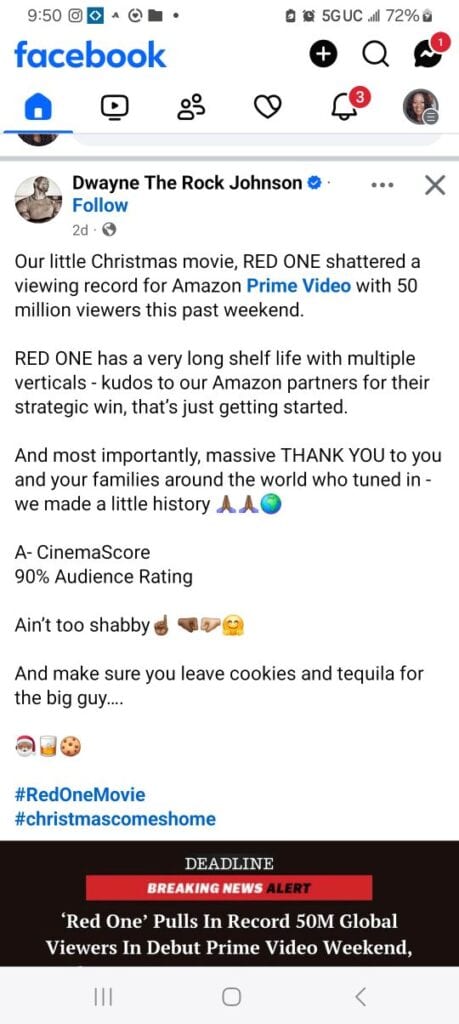
Dwayne Johnson celebrating Red One‘s Prime Video debut. The film drew a reported 50 million viewers worldwide in its first weekend on the service, the most-watched movie debut in Prime Video’s history at the time. (ComingSoon, December 2024)
Every Brand Needs to Think Like a Studio
Turns out Red One is a single door in Amazon’s robust ecosystem. Each franchise represents another set of doors, each one designed to bring in a different kind of person and give them a reason to stay inside the platform.
And that’s when my brain made the jump it always makes when I find a pattern that maps cleanly to profits:
Every brand is going to have to think like a studio now.
Not because of AI. Or Amazon. But because of how people consume content. Because of the interest graph: the invisible web connecting people to their niches, their fandoms, their specific weird obsessions.
Because the only scalable path forward for any brand is building a structure where each piece of content, each product, each piece of IP is a door. Where different people can come in through different entry points. Where once they’re inside, you have enough to keep them. And enough first-party data to inform a strategy that sophisticated.
A brand ecosystem is a structure where every piece of content, every product, and every piece of IP is a door. Different people come in through different entry points, and once they’re inside, there’s enough there to keep them.
That’s a brand ecosystem.
Just two months later, the next step in the evolution of Blue Puddles started to take shape, when the pipeline broke and I had to rebuild it. Not with new keyword research, but with first-party data. It was July 2025 before I pegged empathy as the lever, and had language for what that meant for the brands I work with, and for the machines that recommend them.
Frequently asked questions
What does a brand ecosystem look like for a small business, not a studio?
Smaller doors, same idea. A guide written for one type of customer is a door. So is a free tool, a case study for one industry, or a video answering one specific question. Each one catches a different person with a different first question, and the rest of your site (your services, your newsletter, your other guides) is what keeps them inside once they’re in.
How does this connect to Blue Puddles?
Blue Puddles are small, defensible pockets of expertise where a business has unusually strong proof and real demand. In ecosystem terms, each puddle is a door you can actually own. This piece is where the door idea started. Part 2 is how I found the puddles worth building doors for, using what customers said on sales calls instead of keyword tools.
Visibility Engineer, founder of Five-Talent Strategy House, and lead of the Detroit Media & Innovation Lab. Sixteen years in B2B writing and search. She builds the frameworks behind her work in public, including Blue Puddles and the Minimum Viable Knowledge Graph.
We’ll map the ways buyers can find you today, where the doors are missing, and which ones are worth building first.
Schedule a Strategy Call